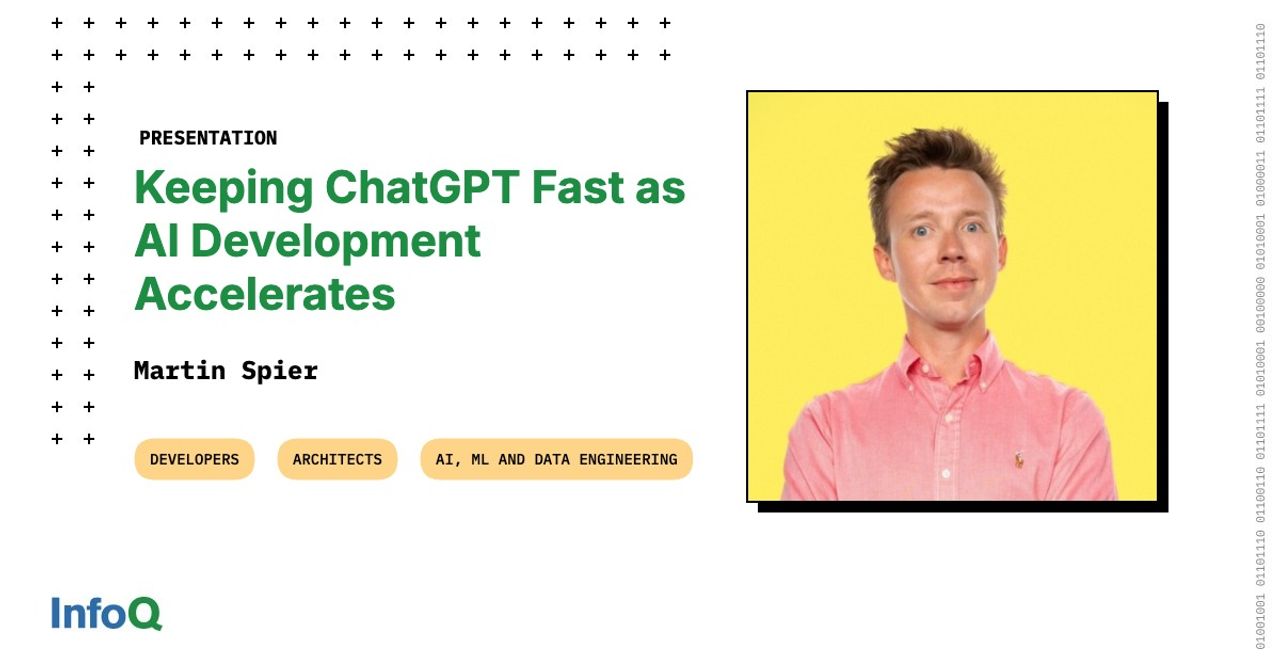
OpenAI's Martin Spier makes a point most executives are missing amid the agentic-coding gold rush: when AI writes and ships far more code, the bottleneck shifts from developer output to systemic performance. The compute conversation fixates on GPUs, but the quieter tax is latency creep, regression, and architectural drift accumulating with every merged change.
The global implication is a structural one. For a decade, the constraint on software velocity was human throughput, so review, QA, and performance testing were sized around a human pace of change. Agentic workflows break that assumption. If agents can generate ten times the diffs, then human-paced profiling and regression detection simply cannot keep up, and product speed silently degrades until users feel it. Spier's answer, deploying always-on agents to automate profiling and continuous optimization, points to where the discipline is heading: performance engineering itself becomes an autonomous, machine-driven loop rather than a periodic human ritual. This reframes 'AI productivity' as a systems problem, not a coding one, and it favors organizations that already treat observability as a first-class capability.
There is a competitive edge hidden here too. As agentic tools like Claude Code push toward less human oversight, the differentiator won't be who ships fastest, but who can ship fast without accumulating invisible performance debt. Speed without guardrails is a liability at scale.
For Japanese enterprises and SIers, this is a sharper warning than it first appears. The domestic model still leans on labor-intensive manual QA, waterfall review gates, and headcount-based delivery contracts. Agentic coding that floods those gates will expose them as the new bottleneck, and clients paying per developer-hour will question why velocity isn't translating into value. SIers that reposition around automated performance observability, regression-detection agents, and outcome-based SLAs can turn this into a service line rather than a threat.
The RPA and local dev-team angle is equally direct. Legacy RPA vendors have sold 'automation' as scripted task replacement, but the frontier is now self-monitoring optimization agents that watch production continuously. Japanese teams should treat performance tooling not as an afterthought bolted on before release, but as core infrastructure procured alongside any agentic-coding rollout, lest faster shipping quietly erode the reliability their customers expect.