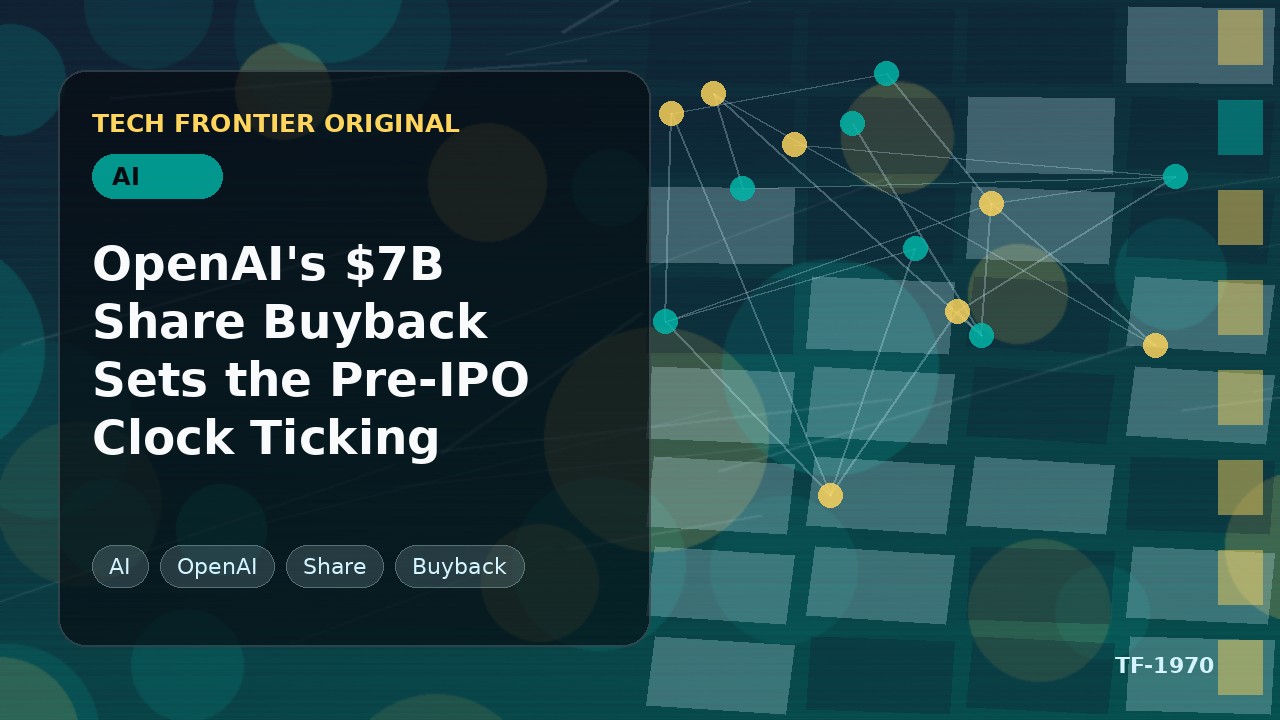
OpenAI let employees cash out roughly $7 billion in shares via a tender offer, a move that typically precedes a public listing. That single fact carries more strategic weight than the number itself.
The global signal is about talent economics, not fundraising. Frontier AI labs compete in a market where a single senior researcher can command compensation rivaling a small acquisition. Paper equity does not pay mortgages or retain people being courted by Meta and others with nine-figure packages. By engineering liquidity while still private, OpenAI is buying loyalty and buying time, deferring the governance and disclosure burdens of a real IPO while neutralizing the poaching pressure that has defined the past year. Expect Anthropic, xAI, and Mistral to face the same math. Secondary liquidity is becoming a standard retention instrument in the AI arms race, and the investors funding these tenders are effectively underwriting a talent war disguised as a capital event.
There is a second-order read for anyone financing the AI stack. Pair this with the wave of Wall Street-backed infrastructure vehicles now flowing into datacenter buildout, and a pattern emerges: private capital is being asked to shoulder both the compute and the human cost of frontier AI long before public markets get a clean shot at pricing the risk. The eventual IPO valuation will have to justify years of pre-listing liquidity already extracted.
For Japan, the implication is uncomfortable but clarifying. Japanese enterprises and SIers are not building foundation models, they are integrating them, which means their exposure runs through vendor stability and pricing. An OpenAI marching toward public markets will face pressure to convert usage into margin, and API and enterprise-license costs are the obvious lever. Firms betting their generative-AI roadmaps on a single frontier vendor should treat this as a prompt to negotiate multi-year terms and design for model portability now.
The talent lesson lands closer to home. Japanese tech employers still lean on tenure and stability rather than liquid equity, and that model looks increasingly fragile as global labs normalize cash-out events for engineers. SIers and product firms hoping to retain scarce AI talent will need to rethink compensation structures, or watch their best people follow the liquidity abroad.