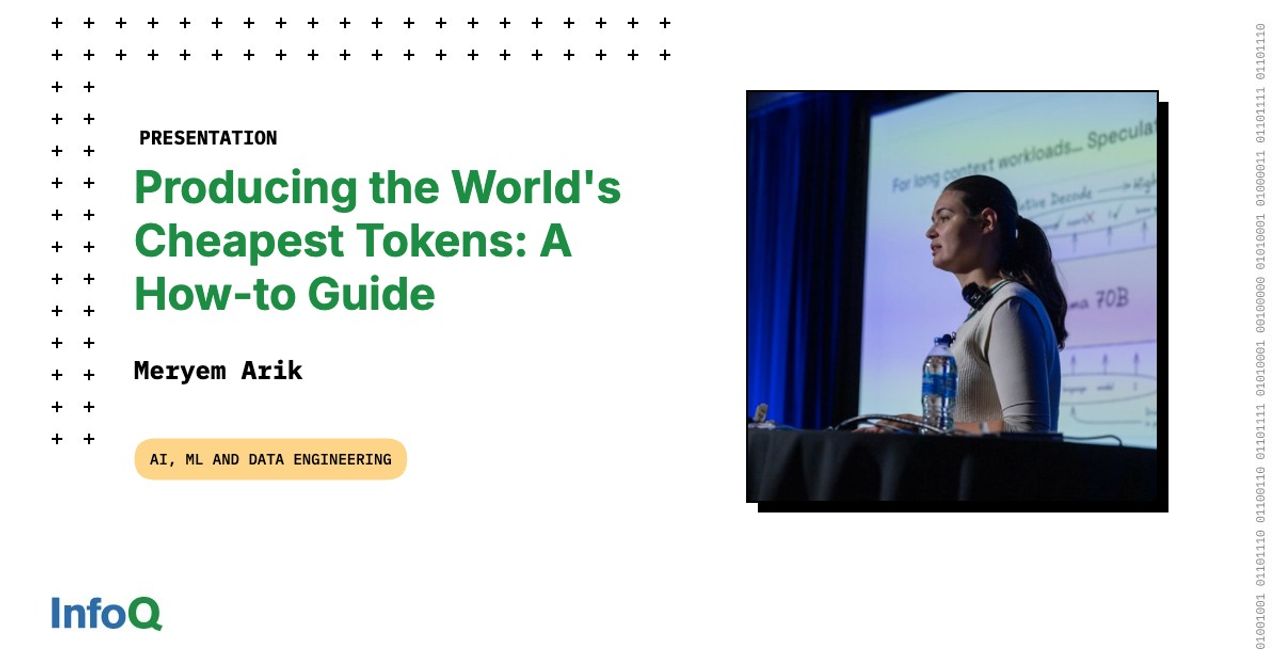
The core argument is simple but underappreciated: order-of-magnitude cost reductions in LLM inference come not from a better model but from deliberate trade-offs across hardware, runtime, speculative decoding, and queue reordering—especially for high-volume, non-real-time workloads.
That framing lands at a pivotal moment. The frontier-model race is converging. With DeepSeek, Qwen, and other open-weight releases pushing capable models into commodity territory, raw intelligence is no longer a durable moat. What increasingly separates a profitable AI product from a money-losing one is unit economics—cost per useful token delivered. Nvidia lining up $500B for datacenter capacity underscores that compute is the scarce, expensive input. The winners will be the teams who treat inference as a systems-engineering problem, not a hosted API call.
The strategic implication for global product leaders is a bifurcation of workloads. Real-time, latency-sensitive tasks justify premium hosted endpoints. But the fat middle—batch summarization, document processing, offline enrichment, agentic pipelines that run overnight—can tolerate latency in exchange for dramatically lower cost through batching, self-hosting quantized open weights, and smart scheduling. Ignoring that split means overpaying by 10x on the majority of tokens.
For Japan, this reframes the AI conversation in a way that plays to local strengths. Most Japanese enterprises are still consuming AI through per-seat SaaS or metered API pricing, treating token cost as a fixed utility bill. As adoption scales from pilots to production, that bill becomes a board-level line item—and the ability to engineer it down becomes a genuine differentiator.
This is a direct opening for SIers. Rather than reselling foundation-model access, integrators like the majors and their subcontractors can build a new practice: inference cost engineering—capacity planning, open-weight self-hosting on domestic or sovereign infrastructure, and workload triage that routes non-urgent jobs to cheap batch pipelines. It also reshapes RPA. Legacy rule-based automation vendors migrating to LLM-driven agents will feel margin pressure fast; the ones who master cheap batch inference for back-office volume will survive the transition. For Japanese development teams, the near-term skill premium moves from prompt crafting toward serving infrastructure—vLLM-style runtimes, quantization, and throughput optimization—competencies that are scarce locally and worth investing in now.