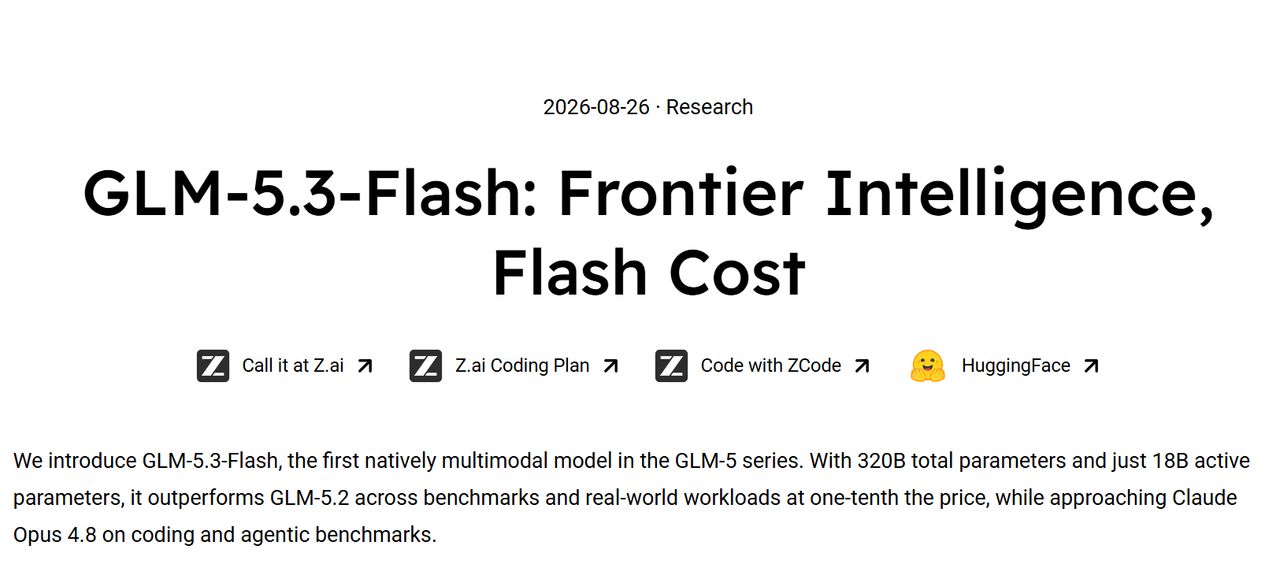
Zhipu confirmed that the anonymously benchmarked "Ox Alpha" is GLM-5.3-Flash, a 320-billion-parameter mixture-of-experts model activating 18 billion parameters per pass, and released the weights openly. It is the first natively multimodal entry in the GLM-5 line, handling text, images, video, and visual documents. Arriving alongside Qwen's latest Flash release, it is another signal that China's open-weight cadence now outpaces most Western labs on frequency alone.
The headline capability is not the parameter count. It is the disclosure, via Pandaily, that the model was served on a cluster of more than 100,000 domestic accelerators at efficiency Zhipu describes as comparable to Nvidia. Treat that claim with appropriate skepticism until independent throughput and cost data surface, but the strategic intent is unmistakable. China is building a full-stack narrative in which frontier training and inference no longer depend on export-restricted Western silicon. If even partially true, it erodes the assumption that GPU controls can cap Chinese model progress, and it hands enterprises outside China a low-cost, permissively licensed alternative to closed API incumbents.
For global buyers, the calculus shifts toward a two-tier market: closed frontier models from OpenAI, Anthropic, and Google for the highest-stakes workloads, and a widening pool of capable open weights that collapse the cost of everything below that frontier. Multimodal open weights in particular pressure vision-heavy SaaS pricing, since document understanding and video analysis can increasingly run in-house.
For Japanese enterprises and SIers, this is both opportunity and governance headache. Open weights let firms fine-tune and self-host behind their own perimeter, which aligns with the sovereignty and data-residency concerns that have slowed cloud-AI adoption in regulated sectors like finance, manufacturing, and government. A 18-billion-active MoE can plausibly run on modest on-premise hardware, lowering the barrier for the mid-market clients that dominate Japan's integrator pipelines. But provenance is the catch. Chinese-origin models carry procurement, security-review, and reputational scrutiny that many Japanese boards and public-sector buyers will not clear quickly, and "released weights" does not mean audited supply chain.
The practical move for SIers is to build model-agnostic architectures now: an abstraction layer where GLM, Qwen, Llama, or a domestic Japanese model can be swapped per client risk profile. RPA and workflow vendors should treat cheap multimodal inference as a direct input-cost deflator, not a threat, and pass those economics into document-automation and inspection use cases where Japan has deep demand.