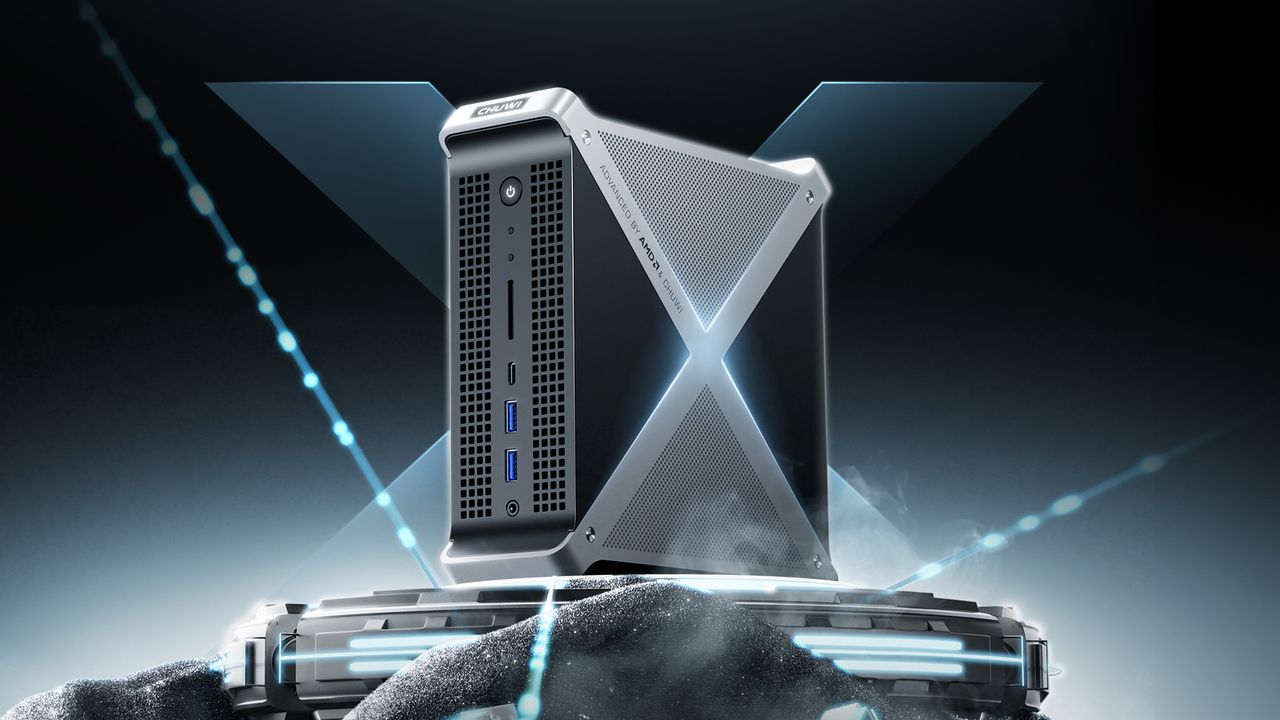
The headline fact is simple: CHUWI's UniBox AI495 Pro fits 192GB of unified memory and AMD's Ryzen AI Max+ PRO 495 into a 2.9-liter chassis, enough to run models up to 300B parameters on a desk. The strategic signal is larger than any single box.
What matters is the commoditization of local inference. When a sub-$3,000-class device (price not disclosed here, so treat that as directional) can host frontier-scale models without a network round-trip, the economic case for routing every token through a hyperscaler API weakens. Cloud inference will remain dominant for training and elastic peak demand, but a growing band of steady-state workloads—internal RAG, code assistants, document processing—becomes cheaper and more predictable on owned silicon. The competitive pressure lands on per-token API pricing and on the assumption that AI value must accrue to whoever owns the datacenter. AMD, notably, is using unified memory bandwidth to attack the one bottleneck that kept large models off consumer hardware, giving it a wedge against Nvidia in a segment Nvidia has underserved.
The quieter implication is data gravity. Sensitive workloads that legal and compliance teams never wanted in a shared cloud now have a viable on-premises home. That reframes AI adoption from a bandwidth-and-egress problem into a fleet-management one.
For Japan, this hits a specific nerve. Enterprises here have been slow to send regulated data—financial records, personal information under APPI, manufacturing IP—to overseas cloud regions. A capable local-inference appliance sidesteps that hesitation entirely and could accelerate adoption in exactly the risk-averse firms that stalled on cloud AI. For SIers, the opportunity is real but the model shifts: less reselling of cloud consumption, more integration, model fine-tuning, security hardening, and managed on-prem fleets. That is a higher-margin, stickier business than pass-through cloud markup, but it demands genuine ML engineering depth rather than license arbitrage.
RPA vendors and their integrators should read this as a runway extension. Local models make it feasible to embed reasoning into automation flows on-site—invoice handling, form extraction, ticket triage—without the latency, cost, or compliance friction of external APIs. The near-term risk is fragmentation: a wave of prosumer-grade boxes without enterprise support, patching, or thermal reliability could leave Japanese buyers holding hardware that ages fast. The teams that win will treat these devices as one node in a hybrid architecture, not a cloud replacement.