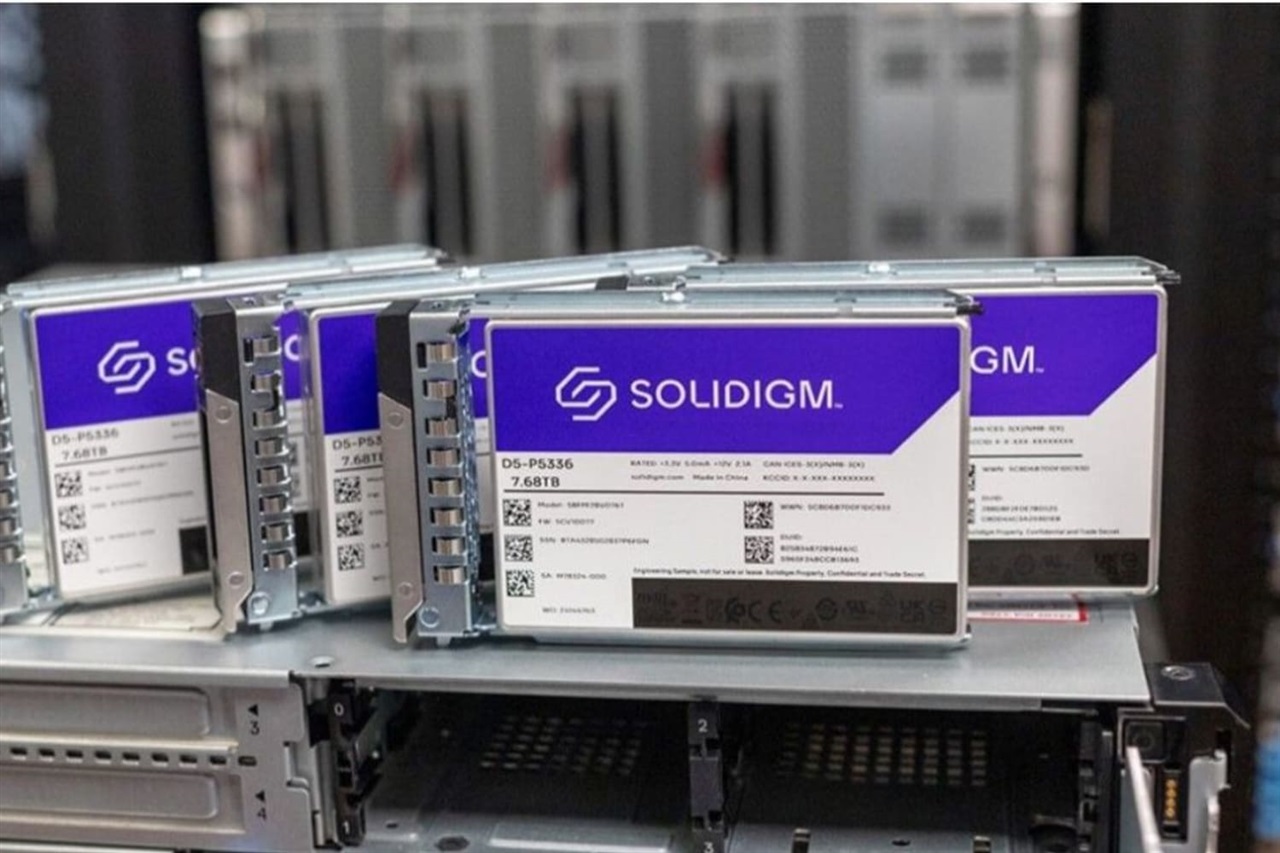
SK Hynix is weighing a US IPO of its NAND subsidiary Solidigm as early as 2027, with reported ambitions of a valuation near $150 billion and roughly $15 billion in fresh capital. The number is the story. It reframes NAND not as a commoditized, cyclical afterthought to DRAM, but as strategic infrastructure for the AI buildout.
The logic is straightforward. AI training and inference clusters are voracious consumers of high-capacity enterprise SSDs, particularly QLC drives that let operators pack petabytes into fewer racks while sipping less power than legacy storage tiers. Solidigm, built on the assets Intel sold off, has quietly become a leader in exactly that segment. If capital markets are willing to price storage the way they price GPUs and HBM, SK Hynix would be foolish not to monetize the premium while the window is open. But that premium is the risk. NAND has never escaped its boom-bust rhythm, and a $150B tag prices in years of uninterrupted hyperscaler capex. Any pause in data-center spending, or a supply glut as Samsung and Micron ramp QLC, could compress the multiple violently. This is a bet that AI storage has structurally decoupled from the old cycle. It hasn't proven that yet.
For Japan, the read-through is sharper than it looks. Kioxia, the country's NAND champion and itself freshly public, competes directly with Solidigm in enterprise QLC. A richly valued Solidigm IPO would set a comparable that lifts Kioxia's own re-rating case, while simultaneously handing SK Hynix a war chest to outspend rivals on capacity. Tokyo policymakers already treat memory as economic-security infrastructure, and a US-listed Korean champion raising $15B changes the subsidy math for keeping Kioxia and its Yokkaichi fabs competitive.
For Japanese enterprises and SIers, the practical signal is a coming shift in data-center architecture. As high-capacity SSDs displace HDD tiers and reshape storage economics, integrators building on-prem AI infrastructure for finance, manufacturing, and government clients will need to rethink capacity planning, power budgeting, and vendor lock-in around QLC-first designs. The teams that treat storage as a strategic layer rather than a line-item commodity will price AI workloads far more accurately over the next three years.