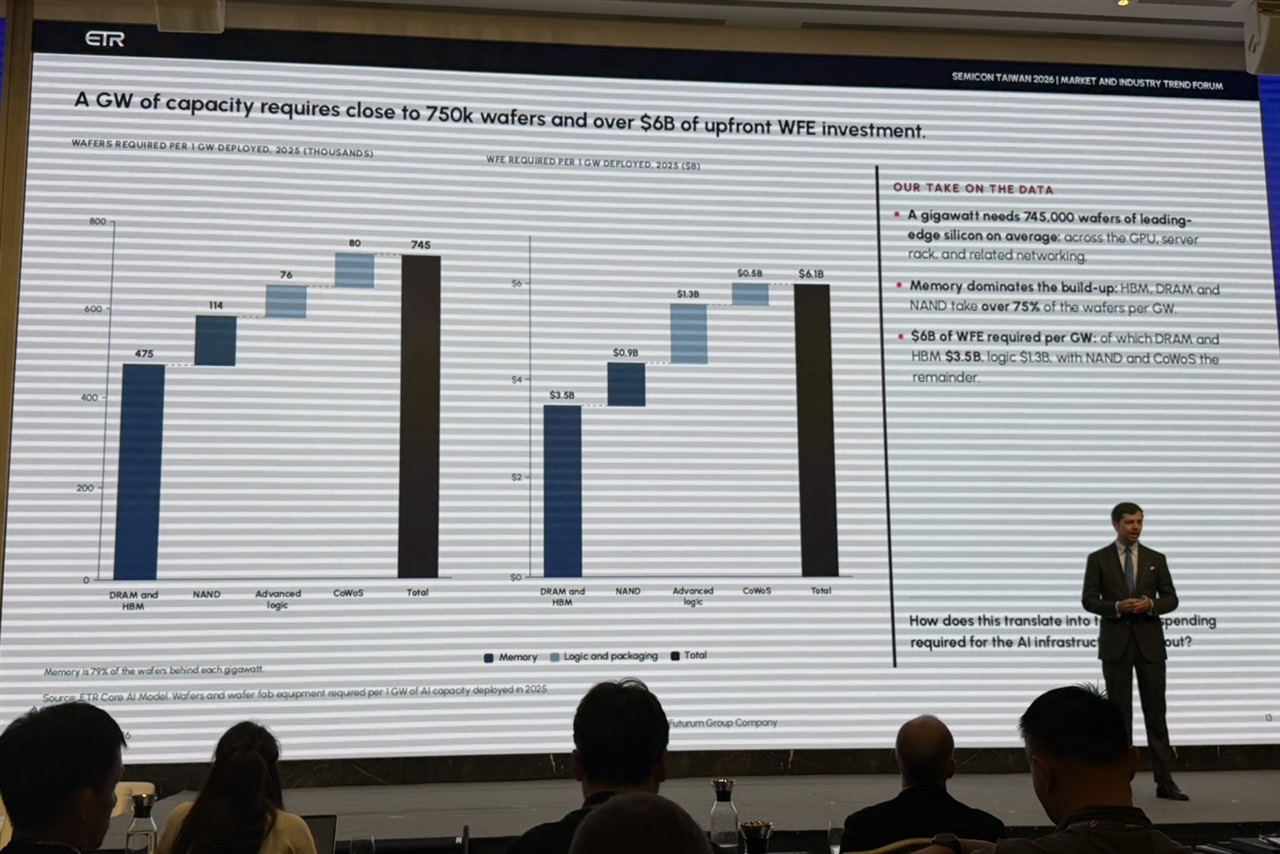
Global wafer fab equipment spending could climb to roughly US$270 billion by 2030, driven by data-center demand for advanced logic, high-bandwidth memory, DRAM and advanced packaging capacity, according to Futurum Group.
The more interesting signal isn't the headline number—it's where the money flows. WFE spending has historically tracked smartphone and PC cycles. This projection reflects a structural break: the demand curve is now anchored to gigawatt-scale AI infrastructure. When a single operator commits billions to a one-gigawatt facility, the order book that ripples back to equipment vendors is measured in years, not quarters. That lengthens visibility for toolmakers but concentrates risk—capacity planned against a frontier-model buildout is only as durable as the assumption that inference and training demand keep compounding. If model efficiency gains or a funding pullback cools datacenter capex, advanced-node and HBM tool orders are the first to feel it.
The center of gravity is also moving inside the fab. Advanced packaging and HBM stacking are becoming the real bottleneck, not lithography alone. That reweights the equipment mix toward bonding, inspection, test and thermal-management tools—segments where the incumbent leaders differ from the classic front-end names. Executives modeling 2030 supply should treat packaging capacity, not wafer starts, as the binding constraint.
For Japan, this is a rare tailwind that plays to genuine structural strength. Japanese suppliers hold commanding positions in exactly the niches this cycle favors: cleaning, coat/develop, test and handling, dicing and grinding, and mask inspection. As packaging and memory-test intensity rises, more of each fab's budget lands in Japanese-dominated categories rather than in areas where Japan lacks presence, such as EUV scanners. Firms like Tokyo Electron, Advantest, Screen, Disco and Lasertec are positioned to capture disproportionate share of the packaging-and-test uplift, and Japan's materials and precision-components base compounds that advantage.
The caveat for Japanese enterprises is concentration risk. This upside is tied tightly to a handful of hyperscaler and foundry buyers, so demand is powerful but lumpy. For domestic SIers and enterprise IT, the second-order effect is more relevant than the equipment trade: as AI compute capacity expands globally, the constraint on Japanese digital transformation shifts from chip availability toward power, cooling and the scarce engineering talent needed to operationalize it. Planning around GPU procurement alone misreads where the real 2030 bottleneck sits.