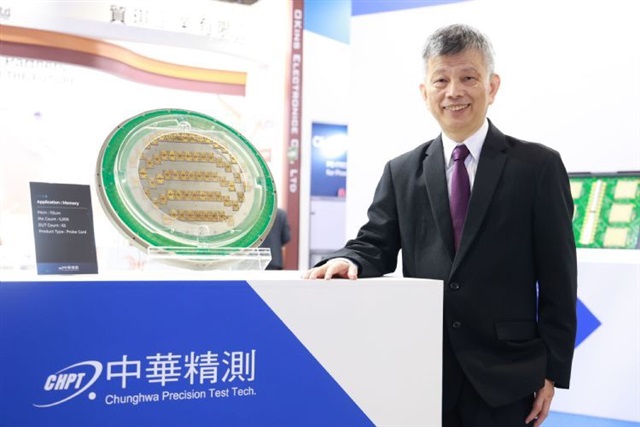
At SEMICON Taiwan 2026, Chunghwa Precision Test Tech (CHPT) put a spotlight on AI probe cards, memory and high-pin-count probe cards, and a high-power burn-in board for AI ASICs. On the surface it's a component showcase; underneath, it signals where the real constraint in AI silicon is migrating.
The industry conversation fixates on foundry nodes and HBM supply, but the harder economics are shifting toward the back end. AI accelerators and HPC ASICs now run at pin counts, power densities, and thermal loads that older test infrastructure was never designed for. Every additional watt an ASIC dissipates during burn-in, every incremental pin on a probe card, raises the cost and risk of validating a die that may already carry five-figure wafer value. When yield-loss at test can strand tens of thousands of dollars per unit, test interface hardware stops being a consumable and becomes a determinant of effective supply. That's why probe card and burn-in specialists are gaining pricing power and strategic relevance they rarely enjoyed in past cycles.
Globally, this tightens Taiwan's grip on the AI hardware stack. TSMC's advanced packaging and a dense local ecosystem of test-interface vendors mean more of the value chain, from wafer probe to system-level test, clusters around the same island. For hyperscalers and fabless AI chip designers, it adds another concentration risk: a disruption in Taiwan now threatens not just fabrication but the ability to validate and ship known-good die at all.
For Japan, the read is more constructive than the usual defensive framing. Japanese firms already hold commanding positions in test equipment and in the precision materials, ceramics, and micro-machined components that go into probe cards and burn-in sockets. Rising test complexity plays directly to that strength, expanding demand for high-reliability interface parts where Japanese suppliers compete on precision rather than price. The opportunity is to move from supplying discrete components to owning more of the high-power, high-pin-count test subsystem that AI ASICs increasingly require.
The strategic caution is ecosystem gravity. If probe-to-system test consolidates around Taiwan, Japan's ambition to build domestic advanced-node capacity risks a missing link: without a co-located back-end test and burn-in supply chain, locally fabricated AI silicon still has to route offshore for validation. Japanese chipmakers, equipment vendors, and industrial policy planners should treat test infrastructure as a first-class part of the sovereignty conversation, not an afterthought bolted on once wafers already exist.