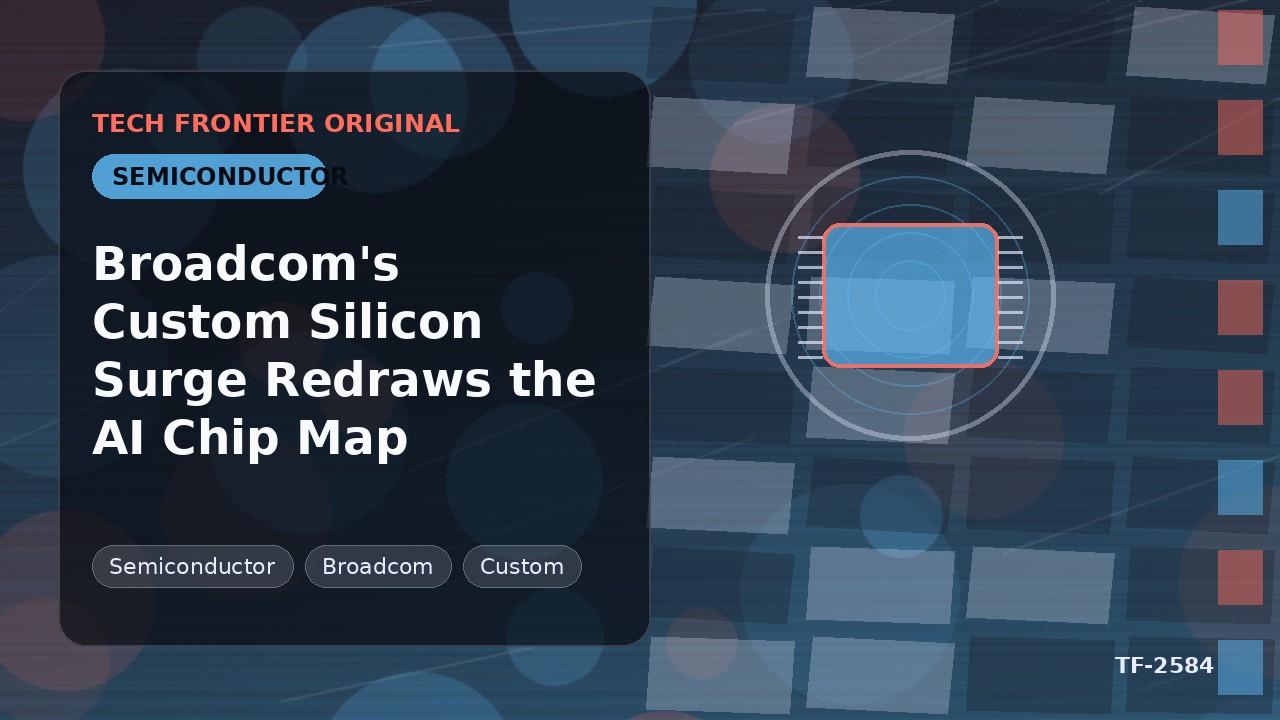
Broadcom posted AI semiconductor revenue of $16.7 billion, up 221% year over year and 54% sequentially, driven by custom compute and large-scale networking rather than off-the-shelf acceleration.
The strategic story here is not the headline number but the composition of demand. Hyperscalers are voting with their capex to reduce dependence on a single merchant-GPU vendor by co-designing their own accelerators, and Broadcom has positioned itself as the arms dealer for that ambition. Custom silicon lets a cloud operator tune performance-per-watt to its specific model workloads and, crucially, escape the pricing power of a dominant supplier. Just as important is the networking half of the equation: as clusters scale to hundreds of thousands of chips, the bottleneck moves from raw compute to how fast those chips talk to each other. Broadcom sits at both ends of that pipe. The implication for the industry is a bifurcation—frontier training may still lean on merchant GPUs, but the high-volume inference and internal workloads of the largest buyers are migrating toward bespoke ASICs, and the value is quietly shifting from the accelerator die to the interconnect fabric around it.
For Japan, the read-through is layered. On the supply side, this validates the bet behind Rapidus and the broader push to re-anchor advanced-node and packaging capability domestically—custom AI silicon is precisely the high-margin, design-intensive segment where Japanese materials, testing, and advanced-packaging players already hold structural strength. The winners are less likely to be chip designers than the equipment and materials firms feeding every fab regardless of whose logo is on the package.
For Japanese enterprises and SIers, the lesson is about architecture, not procurement. As global cloud economics tilt toward custom inference silicon, the cost curve for AI services will keep bending downward, but unevenly across providers. SIers advising clients on AI platform choices should treat the accelerator layer as a moving target and design for portability—abstracting workloads above the silicon so a client is not locked to one vendor's roadmap. Domestic data-center operators betting on generic GPU fleets should study how hyperscalers are quietly redefining the unit economics, because a strategy built purely on merchant hardware may look expensive within a few product cycles.
The broader signal for local dev teams and RPA-heavy shops is that inference is becoming a commodity utility faster than most budgets assume. Planning that treats today's compute prices as fixed will misjudge the next two years.