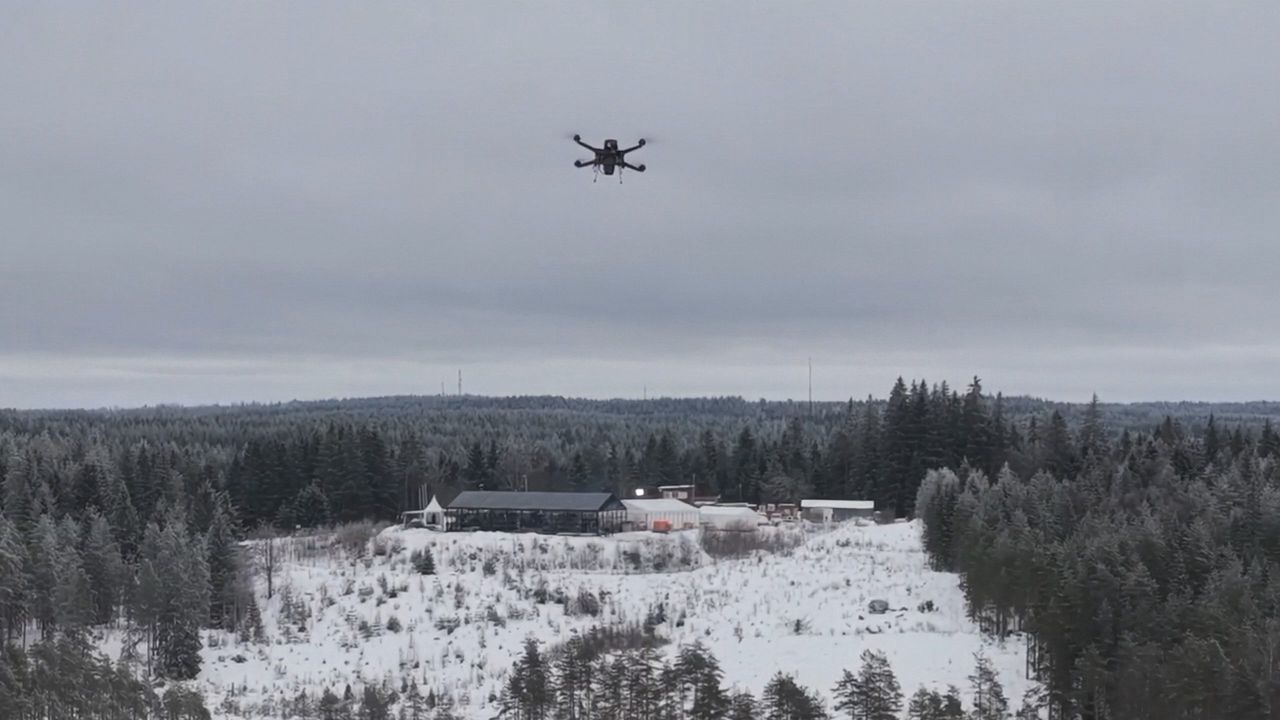
A Swedish startup demonstrated attack drones that use Nvidia's Jetson Orin Nano to run compact computer-vision models, selecting and striking targets with no human operator and no external communications link.
The strategic signal is not the weapon, it's the cost curve. Lethal autonomy no longer requires frontier models or datacenter-scale inference. A palm-sized module priced for hobbyists and industrial vision is enough to close the sense-decide-act loop on the airframe itself. That collapses two barriers at once: the compute budget that once made autonomy a nation-state capability, and the comms dependency that made drones vulnerable to jamming. A system with zero external radio traffic is invisible to electronic warfare and impossible to recall. Proliferation follows from the bill of materials, not from state secrets.
That reframes the policy fight. UN discussions on lethal autonomous systems have moved slowly on the assumption that meaningful autonomy is expensive and rare. Commodity edge silicon breaks that premise, and it puts general-purpose modules squarely in the path of future export-control scrutiny. Vendors selling the same chips into robotics, retail, and manufacturing now carry a dual-use tail they cannot fully police.
For Japan, the read is layered. Tokyo is raising defense spending and pushing domestic drone capability after learning how dependent it was on foreign systems, yet its legal and political posture makes fielding autonomous lethal platforms genuinely fraught. The more durable opportunity for Japanese manufacturers and SIers sits in the civilian half of the same stack. Jetson-class edge pipelines for detection, tracking, and sensor fusion are the identical engine behind factory inspection, agricultural and infrastructure drones, and the physical extension of RPA beyond the screen.
Here the competitive truth is uncomfortable but clarifying: the differentiator is not the model, which is small and increasingly commoditized, but ruggedized integration, reliability engineering, and safety certification. Those are precisely the disciplines Japanese integrators are built around. SIers that treat edge AI as a systems-integration problem rather than a model-training race can win real ground, provided they invest now in on-device inference skills instead of waiting for cloud-first playbooks to arrive at the edge.