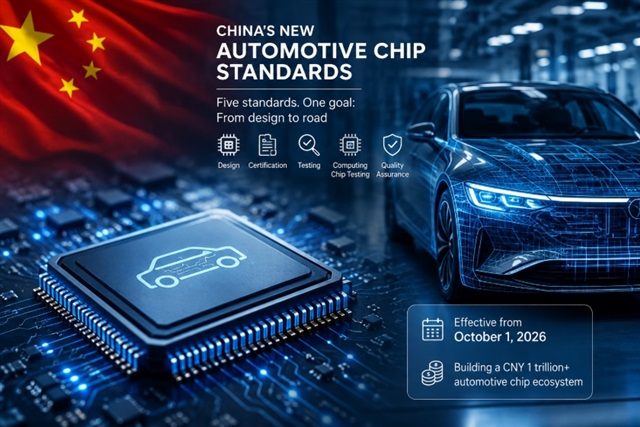
China's release of five certification and accreditation standards for automotive chips looks bureaucratic, but it targets the single hardest gate in the auto semiconductor market: production qualification. Designing a competent chip is one thing; getting it validated to survive a decade under a hood, then trusted by an OEM's safety and liability teams, is another entirely. That validation gap—not raw silicon capability—is why domestic Chinese chips have struggled to displace incumbents like Infineon, NXP, Renesas, and STMicroelectronics inside actual vehicles.
By standardizing the certification pathway, Beijing is building the institutional plumbing that turns a fragmented pool of domestic designers into qualified, drop-in suppliers. This is import-substitution executed at the process layer rather than the product layer, and it is far more durable. Once a domestic testing and accreditation regime is entrenched, the switching cost runs in China's favor: local OEMs gain a compliant, politically endorsed sourcing option, and foreign suppliers face a slow erosion of design-win share in the world's largest auto market.
The global read: automotive is where semiconductor decoupling becomes tangible. Unlike leading-edge AI logic, most auto chips sit at mature nodes China can already fabricate. Certification standards remove the last credibility barrier. Expect incumbent Western and Japanese suppliers to see China revenue plateau, then decline, even as unit volumes there grow—a structural margin problem masked by headline market size.
For Japan, this is a direct strategic threat. Renesas derives a meaningful slice of its automotive MCU and power business from China-facing demand, and Japan's broader supplier ecosystem—Rohm, Toshiba, Sony's sensing units—has treated Chinese EV makers as a growth engine. A homegrown certification regime that favors domestic parts compresses that runway. Japanese suppliers must assume their China auto exposure carries a rising localization discount and accelerate design wins elsewhere—India, ASEAN, and the reshoring North American EV base—to offset it.
Japanese SIers and automotive software integrators should also note the second-order effect: as chip sourcing bifurcates by geopolitical bloc, so will the software, toolchains, and functional-safety validation stacks built on top. Firms supporting Japanese OEMs' China operations will increasingly need dual-stack competence—supporting both incumbent and Chinese-certified silicon—raising integration complexity and cost. The prudent move now is scenario-planning for a China auto market where the reference bill of materials is quietly, deliberately, made local.