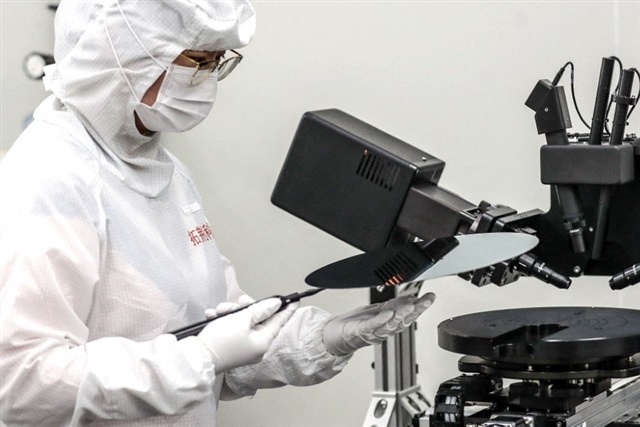
Piotech, a Chinese maker of semiconductor deposition equipment, reported a 1,324% jump in first-half 2026 profit, helped by stronger tool demand, wider adoption of new process equipment, and improving scale economies.
The number itself matters less than what it certifies: China's equipment-localization drive has moved from subsidy-fueled experimentation into commercial traction. Deposition is one of the process steps where domestic vendors had the clearest path to credible tools, because it sits below the extreme-ultraviolet frontier that export controls have walled off. That is precisely why the growth is strategically loud. Beijing is not trying to leapfrog the leading edge overnight. It is building a self-sufficient stack across mature and trailing nodes, where the bulk of automotive, industrial, and power semiconductors are actually made. Profit at scale, not just revenue, tells buyers the supply chain is durable enough to standardize around.
For the incumbents, the risk is a slow erosion rather than a sudden collapse. The global deposition market has been dominated by a small set of US and Japanese firms whose China business became an outsized share of growth during the localization boom. As domestic tools qualify into more fabs, that China revenue converts from tailwind to headwind, and the pricing umbrella that protected fat service-and-consumables margins starts to leak. Every qualified Chinese tool also compounds: it seeds a domestic install base, a local service network, and a talent pool that lowers the switching cost for the next fab.
For Japan, this cuts close. Tokyo Electron and the broader Japanese equipment and materials complex have leaned heavily on Chinese fab expansion, and deposition is a segment where they compete directly. The near-term hit is concentrated in trailing-node capacity inside China, but the strategic question is whether Japanese suppliers can rotate that demand toward Rapidus-era domestic buildout, US and Taiwan expansion, and higher-value modules where Chinese vendors are not yet credible. The materials and precision-parts suppliers that sit beneath the toolmakers face the same fork.
Japanese enterprises and SIers are one layer removed, but not insulated. A bifurcating equipment supply chain forces electronics and industrial OEMs to model two component ecosystems, which reshapes procurement, BOM compliance, and export-control tooling. That is real integration work, less about RPA-style automation and more about traceability systems, dual-sourcing logic, and regulatory data pipelines that local integrators are well positioned to build if they treat supply-chain fragmentation as a durable design constraint rather than a passing shock.