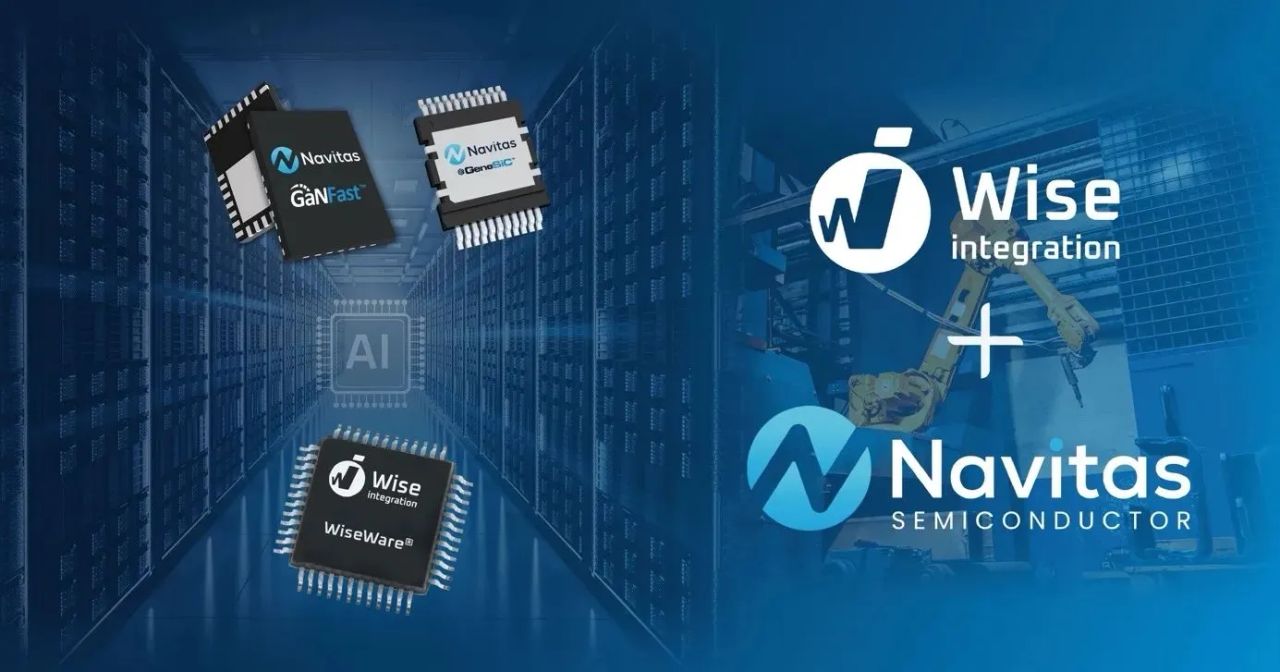
The partnership itself is a footnote. The signal underneath it is not. Wide-bandgap semiconductors — gallium nitride and silicon carbide — are moving from a niche efficiency play into the critical path of AI infrastructure economics. As rack densities climb toward 100kW and beyond for GPU clusters, the losses inside legacy silicon-based power supply units stop being a rounding error and start dictating how much usable compute a given megawatt of grid capacity can actually deliver.
The global calculus is straightforward. Power is now the binding constraint on frontier AI, not chips. Every percentage point of conversion efficiency recovered at the PSU stage compounds across thousands of racks, translating directly into lower cooling load, higher compute-per-watt, and shorter payback on datacenter capex. That is why control-IP firms and GaN device makers are consolidating around integrated reference designs — hyperscalers want validated, drop-in power stages, not a components bill of materials they have to engineer themselves. Expect the value in this stack to migrate toward whoever owns the digital control layer, because that is where efficiency, telemetry, and reliability are tuned.
There is also a supply-chain subtext. GaN and SiC capacity, packaging, and the control silicon around them are becoming strategically sensitive in the same way advanced logic already is. Whoever can guarantee volume and yield on high-density power components gains leverage over the datacenter buildout timeline.
For Japan, this is a rare offensive position rather than a defensive one. Japanese firms hold genuine strength across the power-electronics and wide-bandgap value chain — from SiC substrates and discrete devices to passive components and precision manufacturing. The demand pull from AI datacenters is exactly the kind of high-margin, reliability-critical market where Japanese materials and component makers historically win. The risk is that the design-win and integration layer, where margins and standards get set, gets defined overseas while Japan supplies commoditized inputs.
For Japanese SIers and datacenter operators, the practical implication is that power architecture is becoming a first-class design decision, not a facilities afterthought. Teams planning domestic AI infrastructure — including the sovereign-compute and regional datacenter projects now gaining momentum — should be evaluating GaN-based power topologies for their impact on total cost of ownership and grid footprint, not just server GPU counts. In a market where power availability and electricity cost are acute constraints, conversion efficiency is a competitive lever, and the SIers who understand it early will win the buildout mandates.