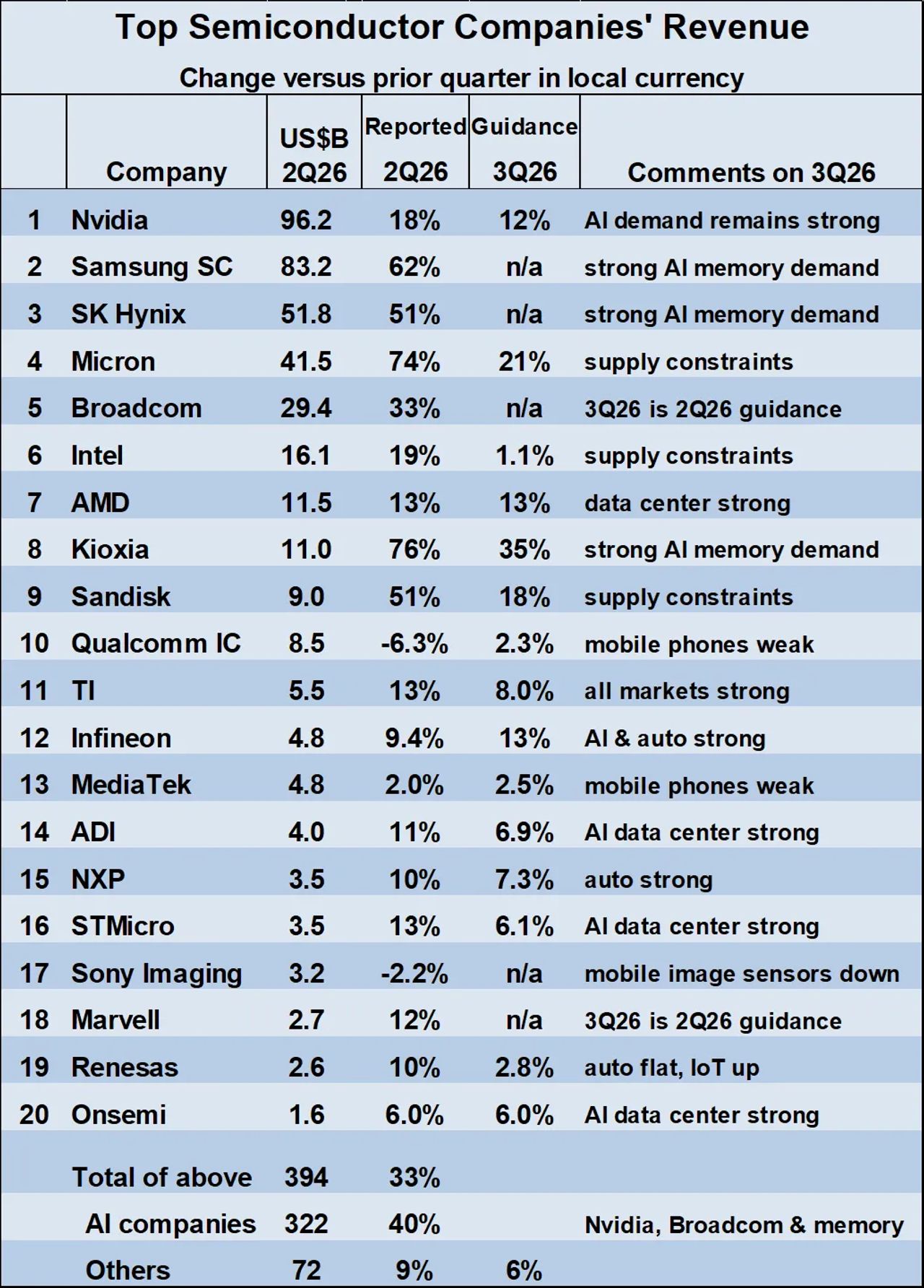
The headline number tells the story of a market that has flipped from glut to scarcity in barely a year. WSTS puts the global semiconductor market at $368bn in Q2 2026, up 35% quarter-on-quarter, and memory is the engine. What matters strategically is not the growth rate itself but its composition: AI datacenter buildout is absorbing high-bandwidth and high-density memory faster than fabs can add capacity, and that pull-through is now rippling into commodity DRAM. When Google is telling Android developers to trim memory footprints, the message is clear — the supply tightness has crossed over from the datacenter into consumer devices.
Globally, this creates a two-speed outcome. Memory makers regain pricing power and margin after a brutal down-cycle, while everyone downstream — smartphone OEMs, PC vendors, automotive and industrial electronics — faces rising bill-of-materials costs and allocation risk. Expect procurement teams to return to long-term supply agreements and prepayments, the same defensive playbook seen in prior shortages. The bottleneck also hands leverage to the handful of firms controlling advanced memory capacity, reinforcing concentration in an already concentrated supply base.
For Japan, the dynamics cut both ways. On the supply side, Japanese players sit closer to this cycle than in most tech stories — Kioxia in NAND, plus the materials and equipment vendors that feed global fabs, stand to benefit directly from sustained memory demand. That is a genuine tailwind for a segment where Japan retains real structural strength.
On the demand side, the picture is harder. Japanese electronics and automotive manufacturers that embed memory into finished products will absorb higher input costs, and yen weakness amplifies the import bill for dollar-priced chips. Enterprise IT will feel it too: server refresh cycles, on-prem AI infrastructure, and cloud contract renewals all carry memory cost embedded in the price.
SIers and corporate IT planners should treat this as a budgeting signal, not a passing spike. Projects scoped in the low-price era of 2024-25 may need re-estimation, and hardware-heavy proposals should build in memory cost volatility. The practical hedge is architectural — memory-efficient application design, workload consolidation, and a harder look at whether AI workloads truly need on-prem GPU-and-memory stacks or can shift to managed cloud where the provider absorbs allocation risk. In a tightening market, disciplined capacity planning becomes a competitive advantage.