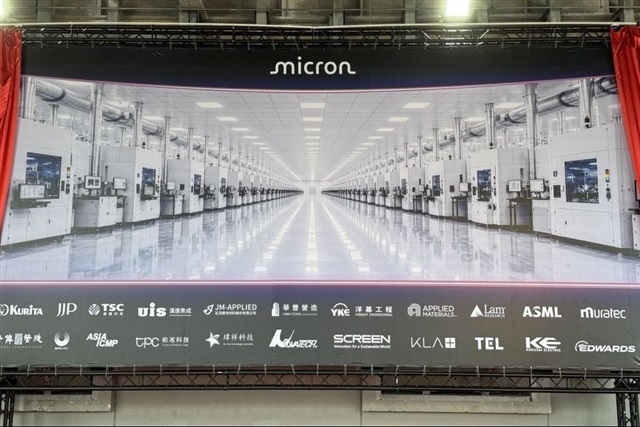
Micron bringing its Tainan fab—acquired from AUO in 2024—online just as it posts record revenue tells you everything about where the memory cycle sits. The bottleneck is no longer DRAM in general; it is high-bandwidth memory (HBM) for AI accelerators, and every additional wafer of Taiwan-based advanced packaging and DRAM capacity is being pre-sold into the datacenter buildout. Dell's simultaneous $25B upward revision on AI server demand is the demand-side mirror of this supply move: hyperscalers and enterprises are ordering GPU-dense systems faster than the memory supply chain can comfortably deliver, and HBM remains the single hardest component to scale. Micron adding capacity is rational; the constraint is human, not silicon.
That is why the labor dispute matters more than a routine footnote. A strike threat at a bellwether memory maker during the tightest HBM cycle in a decade is a genuine supply risk, not an HR story. Taiwan's concentration of both foundry (TSMC) and now expanding memory capacity means labor stability there is a systemic variable for the entire AI hardware stack. Executives modeling 2026 server availability should treat Taiwanese fab-labor relations as a real line item alongside power, packaging (CoWoS), and export-control exposure.
For Japan, the implications run in two directions. On the supply side, Micron's Hiroshima operations sit at the heart of its next-generation DRAM and EUV roadmap, backed by substantial METI subsidies. A stronger, more diversified Micron footprint—Taiwan plus Japan—is strategically favorable for Tokyo's ambition to re-anchor advanced memory manufacturing domestically. But any labor or operational shock in Taiwan raises the pressure, and the expectations, on the Hiroshima ramp to serve as a stabilizing second source.
On the demand side, Japanese enterprises and the SIers building their AI infrastructure face the same HBM scarcity that is driving Dell's numbers. Sovereign AI initiatives, GPU cloud buildouts by domestic carriers and cloud players, and enterprise on-prem AI clusters all compete for the same constrained memory pool. Procurement lead times for AI servers are lengthening, and SIers that have historically treated hardware as a commoditized pass-through will need to manage allocation risk, lock in supply earlier, and advise clients on realistic deployment timelines. The teams that win 2026 AI infrastructure deals will be those that understood memory scarcity as a scheduling and pricing problem before their clients did.
The throughline: AI's cost curve is increasingly set not by model licensing but by the physical memory supply chain, and that chain now hinges on a handful of Taiwanese and Japanese sites where a single labor action can ripple straight into enterprise deployment roadmaps.