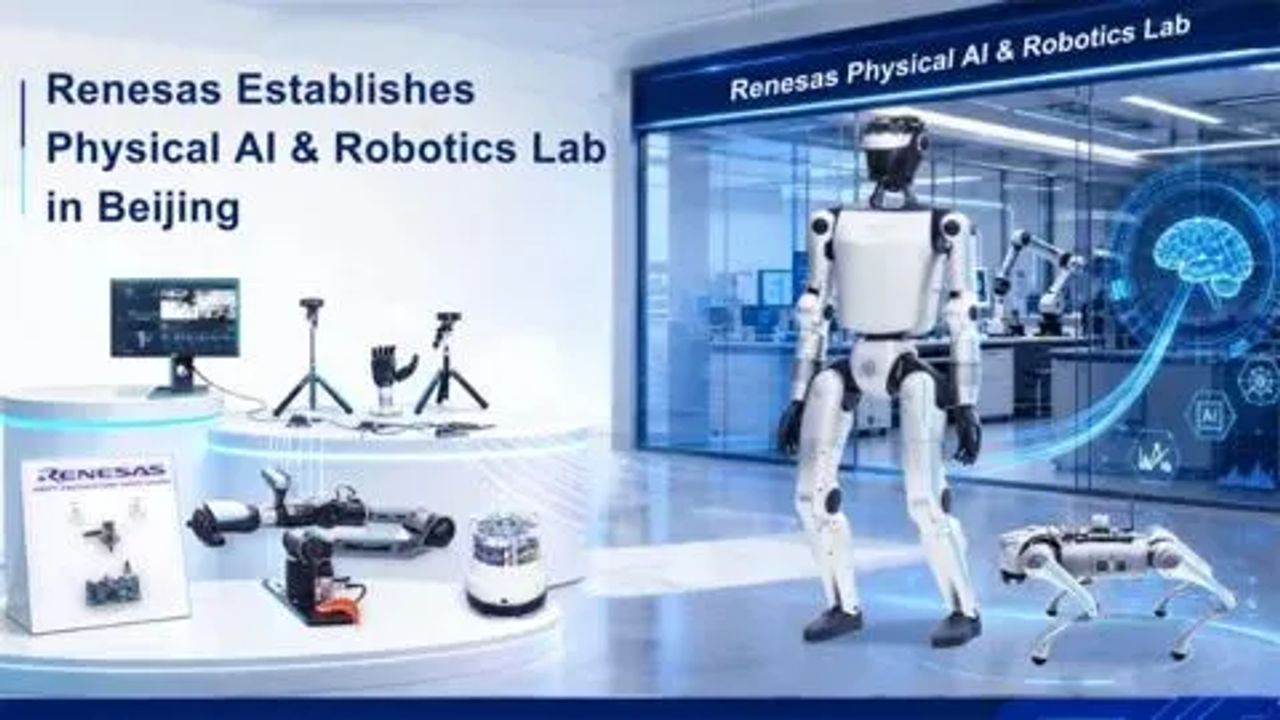
Renesas has opened a Physical AI & Robotics Lab in Beijing, positioned as a hub where customers can demonstrate, validate, and co-develop next-generation robotic systems. The location matters as much as the mission.
The global story here is the race to own the compute layer beneath humanoid robotics. As Anthropic and others push software standards that let AI models operate physical machines and lab equipment, the value chain is splitting into three tiers: the reasoning model on top, an orchestration standard in the middle, and the silicon and motor-control electronics at the bottom. Chipmakers like Renesas live in that bottom tier, supplying the MCUs, motor drivers, and real-time control silicon that turn a language model's intent into torque and motion. Physical AI is where model capability meets hard constraints of latency, power, and functional safety, and that is exactly the ground where an established analog and embedded vendor can defend margins that pure-play AI accelerators cannot easily reach.
Choosing Beijing is a deliberate demand bet. China leads the world in humanoid robot manufacturing ambition, with aggressive state backing and a dense supply chain for actuators and assembly. For Renesas, proximity to that ecosystem means design wins land early in the reference-platform stage, when component choices get locked in for years. The risk is equally clear: escalating US-China export controls and geopolitical friction could strand investments or force awkward decoupling, and a Japanese firm operating an R&D hub in China sits directly in that crossfire.
For Japan, this is a revealing signal. Renesas is choosing to build its physical-AI presence in the market with the fastest robot adoption rather than at home, an implicit verdict on where demand and speed actually live. Japanese manufacturers and robotics integrators have deep hardware heritage but have been slower to fuse it with modern AI orchestration layers. If control silicon and reference designs coalesce around Chinese platforms, domestic industrial players risk becoming downstream buyers of an ecosystem shaped elsewhere.
For SIers and enterprise dev teams, the shift reframes automation strategy. RPA and software-only process automation have dominated Japanese digitalization budgets, but physical AI extends automation into warehouses, factories, and services. The integrators who thrive will be those who can bridge embedded control, safety certification, and AI orchestration, not just wire together SaaS APIs. That is a materially different skill stack, and building it now is the defensible move.