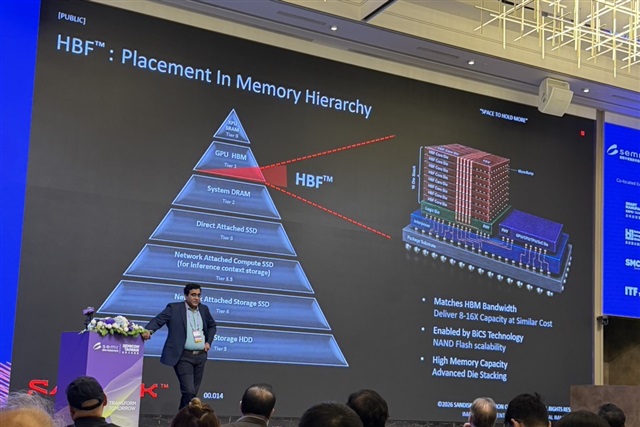
Sandisk is pitching High Bandwidth Flash (HBF), a NAND-based memory that it says matches HBM bandwidth while delivering eight to 16 times the capacity at comparable cost, moving flash physically closer to processors as inference workloads overwhelm today's memory hierarchy. The strategic target is clear: the memory wall, not raw compute, is increasingly what caps large-model economics.
The global logic is compelling on paper. HBM is scarce, expensive, and capacity-constrained precisely as inference volume explodes and context windows balloon. If HBF can park tens of gigabytes of model weights near the accelerator at flash densities, it reframes the buildout math for anyone running inference at scale. Capacity, not just bandwidth, becomes the lever. That makes HBF less a straight HBM replacement and more a new tier between HBM and conventional storage, absorbing the massive read-heavy weight traffic that inference generates.
Skepticism is warranted. NAND's Achilles' heels are latency and write endurance, and bandwidth parity in a spec sheet rarely survives contact with real workloads, thermals, and controller overhead. Ecosystem gravity matters too: accelerator roadmaps, packaging, and software are tuned to HBM. A credible standard, silicon partners, and shipping products are years of work, and Broadcom's softer AI guidance this cycle is a reminder that infrastructure demand is not linear.
For Japan, the read is unusually direct. NAND is one of the few semiconductor segments where Japanese manufacturing remains front-line, so a flash format that rides existing fab investment plays to a domestic strength rather than exposing a gap, unlike leading-edge logic. If HBF gains traction, Japan's memory sector gets a fresh, higher-value demand vector tied to AI rather than commodity storage cycles.
For Japanese SIers and enterprise IT teams, the near-term signal is architectural. Memory tiering is becoming a first-class design decision for on-prem and sovereign inference deployments that many regulated Japanese firms prefer. Teams should treat capacity-per-dollar and memory topology as procurement criteria now, and avoid locking multi-year AI infrastructure plans to a single memory assumption while HBF and HBM roadmaps are still in flux.