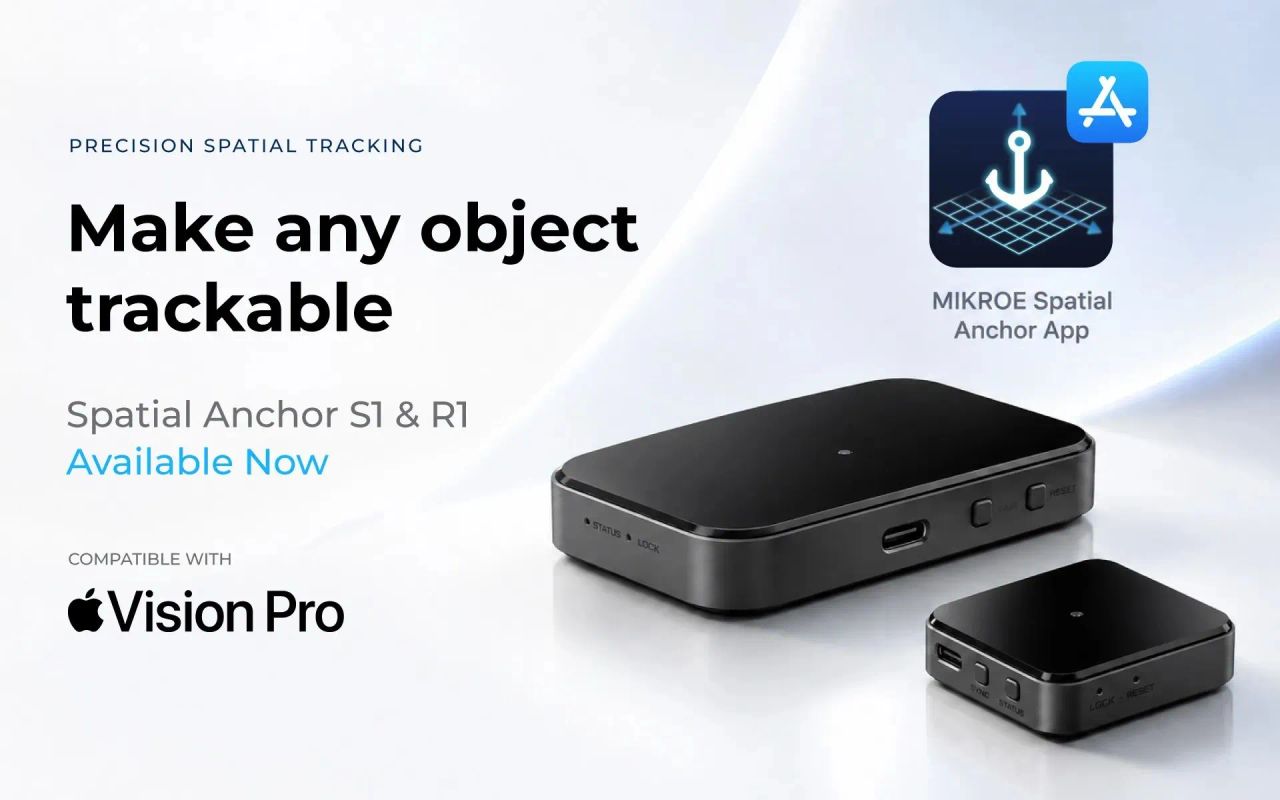
Mikroe has begun shipping its Spatial Anchor S1 and R1 modules, purpose-built to give physical accessories precise spatial tracking inside Apple's Vision Pro. The interesting part isn't the product itself but what it reveals about where mixed-reality value is migrating: away from the headset and toward the components that anchor the physical world to the digital one.
Apple stripped controllers out of Vision Pro to bet on hands and eyes. That decision created a gap. Enterprise use cases—surgical training, industrial assembly, CAD manipulation—still need tactile, precisely-tracked tools. A third-party module ecosystem filling that gap is the clearest signal yet that spatial computing is maturing from a closed demo into an open component market, mirroring how Arduino-style breakout boards once seeded the IoT wave. The strategic risk for Apple is fragmentation; the opportunity for everyone else is a durable, lower-capital entry point that doesn't require building a headset.
For global players, the lesson is that XR margins may accrue less to platform owners and more to the sensor, module, and integration layer beneath them. Precision tracking is a hard problem in optics and firmware, not app design—favoring companies with deep hardware pedigree over software-first startups.
This is where Japan is genuinely well-positioned, and it's worth being specific. The country's strength has never been consumer platform ownership; it's in precision components, optical sensors, and industrial-grade manufacturing. Firms in the motion-sensing, MEMS, and optics supply chain have exactly the capabilities a spatial-accessory ecosystem demands. Rather than chasing headset design, the smarter Japanese play is to own the tracking substrate other people's XR products depend on.
For SIers and enterprise dev teams, the near-term read is more measured. Vision Pro remains a niche, high-cost device, so pouring resources into consumer XR pilots is premature. The pragmatic move is to watch which industrial workflows—training, maintenance, remote inspection—start attaching physical tracked tools, since those are the deployments a Japanese manufacturer or logistics firm might realistically fund. Building integration and firmware competency around spatial modules now, at low cost, positions a SIer to lead when a domestic client finally commits, without betting the practice on a consumer market that may never arrive at scale.