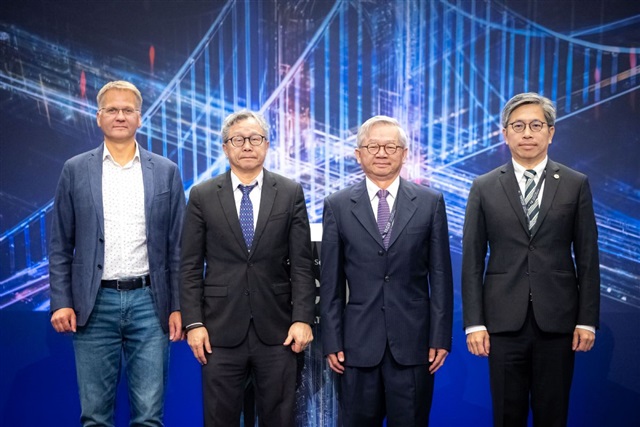
Taiwan's top science official spent early September in the UK and Belgium pushing collaboration on advanced packaging, silicon photonics, and talent exchange. The stated goal was resilience, but the subtext is clearer: Taiwan is diversifying its diplomatic and industrial footprint before geopolitical pressure forces its hand.
Globally, the interesting signal is the choice of topics. Advanced packaging and silicon photonics are exactly where the next decade of value migrates. As transistor scaling slows, packaging becomes the new battleground for performance, and photonics is emerging as the interconnect layer for AI datacenters straining against copper's power and bandwidth limits. By anchoring cooperation in these areas rather than legacy wafer fabrication, Taiwan is positioning to stay upstream of value even as manufacturing capacity spreads worldwide. Belgium's imec and the UK's research base give Europe genuine leverage here—this is not a one-way technology transfer, and both sides know it.
The harder read is talent. Every serious chip nation now competes for the same shallow pool of packaging and photonics engineers. A government-to-government talent channel is a hedge against the workforce bottleneck that has already slowed fab projects from Arizona to Dresden. Capital and equipment are buyable; trained people are not, and that scarcity is becoming the real constraint on the entire buildout.
For Japan, this is a competitive prompt rather than a threat. Japan holds unusual strength in the same layers Taiwan is exporting—packaging materials, photonics research through long-running national programs, and precision equipment. Rapidus and the TSMC-anchored Kumamoto cluster give the country a manufacturing anchor, but the strategic question is whether Japan converts its materials and photonics depth into standards-setting partnerships before Taiwan-Europe axes harden. Tokyo should be pursuing the same trilateral talent and photonics ties, not watching them form around it.
For Japanese SIers and enterprise IT teams, the downstream effect is concrete. Silicon photonics maturing into datacenter interconnects reshapes the cost and power curve of AI infrastructure that clients will demand within a few years. Integrators who understand optical interconnect roadmaps—not just server procurement—will design more defensible AI platforms. The commodity layer keeps shifting; the advisory value moves toward those who can read where the physics is heading.