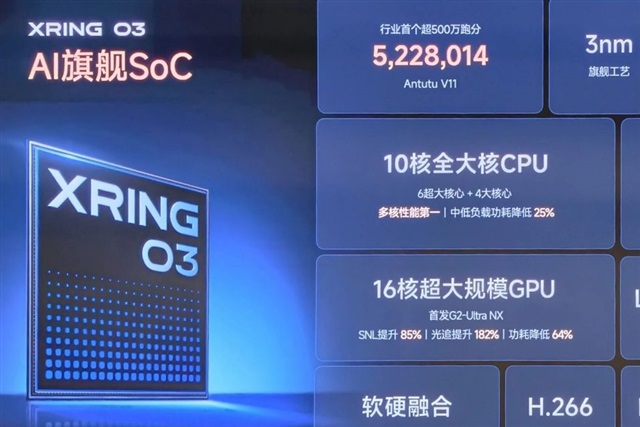
Xiaomi is broadening its Xring silicon program beyond smartphones into AI acceleration and autonomous driving, a move that lowers its dependence on merchant chip vendors but raises its exposure to a single leading-edge foundry.
The strategic logic mirrors Apple's playbook: control the roadmap, tune silicon to your own software, and capture margin that would otherwise leak to Qualcomm or MediaTek. What makes this notable is the breadth. Designing across phones, edge AI, and driving stacks at once implies Xiaomi believes its compute needs are diverging enough from off-the-shelf parts to justify the design cost. The trade-off is blunt. Escaping supplier lock-in on the design side deepens manufacturing concentration on the process side, since only TSMC can reliably deliver these nodes at volume. Geopolitically that is a sharp irony for a Chinese firm: chip independence in architecture, but a tighter tether to a Taiwanese fab operating under US export scrutiny. Any tightening of tooling or node access reshapes that calculus overnight.
For the broader industry, this is another datapoint in the vertical-integration wave. When device makers design their own accelerators, the addressable market for merchant silicon narrows at the high end, pushing chip vendors toward IP licensing, chiplets, and packaging services rather than finished SoCs.
For Japan, the read-through runs through the automotive and equipment layers rather than handsets. Xiaomi's autonomous-driving silicon ambition pressures Japanese automakers and their Tier-1 suppliers, where in-house driving compute has lagged a fragmented ECU model. It also strengthens the case for Japan's materials and equipment ecosystem, from photoresists to inspection gear, since more custom silicon at advanced nodes means more demand upstream regardless of whose logo is on the chip. Rapidus's leading-edge ambitions gain relevance here only if it can credibly offer an alternative to TSMC concentration.
For Japanese SIers and enterprise dev teams, the practical signal is that automotive and edge-AI software work is consolidating onto vendor-controlled silicon stacks. Betting on portable, hardware-agnostic toolchains and abstraction layers becomes the safer engineering posture as more clients standardize on proprietary accelerators they do not control.