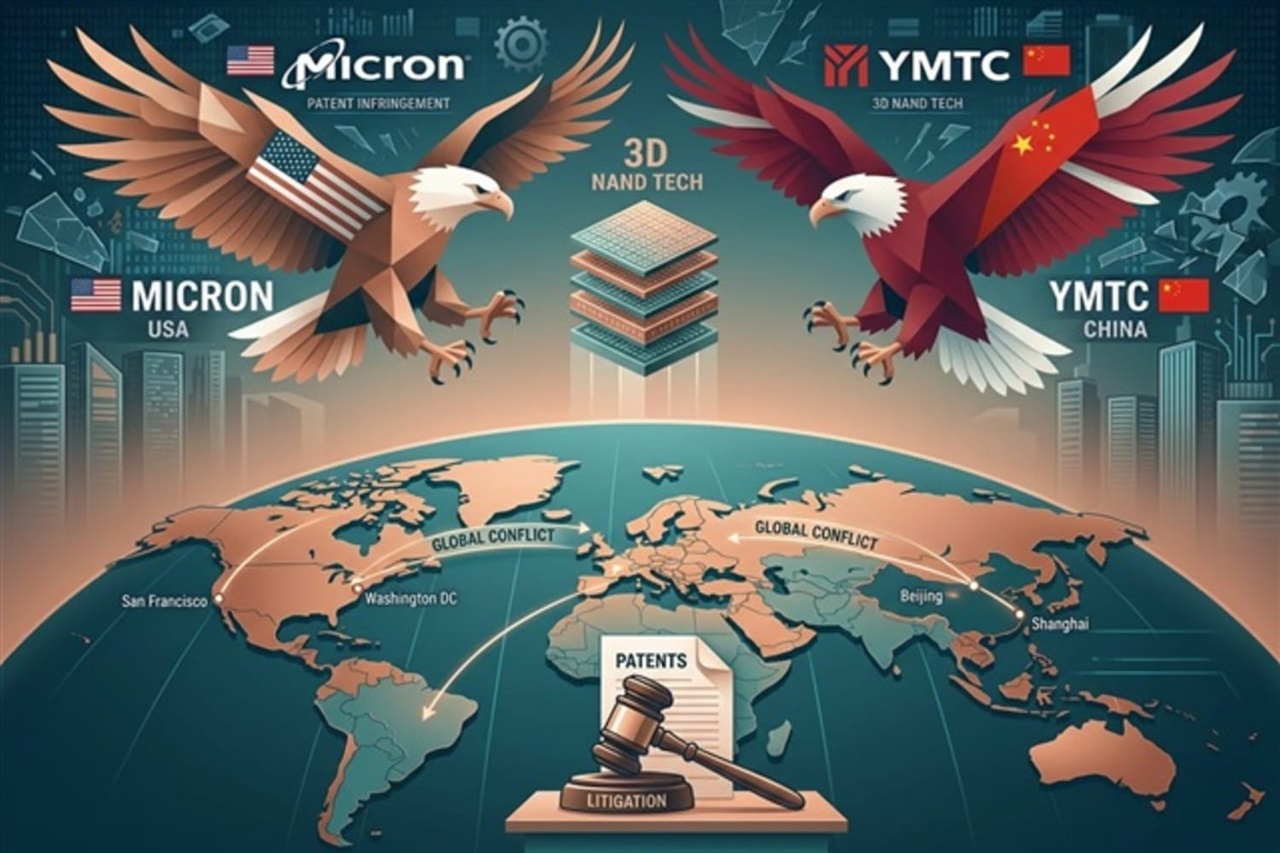
The Munich I Regional Court's decision to grant YMTC two injunctions against Micron over 3D NAND utility models is less about the immediate revenue at stake and more about what it signals: China's memory champion has moved from defense to offense, and it has done so on Micron's turf using Europe's fast, patentee-friendly injunction regime. Germany's bifurcated system, which lets a court order a sales halt before validity is fully litigated, is a favorite venue for aggressive rights-holders. YMTC choosing it deliberately tells you the goal is leverage, not just damages.
The strategic context matters. This dispute traces back to the 2023 escalation and sits inside the broader US-China semiconductor conflict, where YMTC has been export-blacklisted by Washington. Winning injunctions in a third-country jurisdiction is a way to reclaim negotiating power that sanctions stripped away. For Micron, the exposure is concentrated in exactly the segment where design-in cycles are long and switching costs are high: automotive and industrial-control NAND. A German sales restriction, even if narrow or eventually overturned on appeal, forces European Tier-1 suppliers to model second-source contingencies now rather than later.
The wider read for global executives is that IP litigation is becoming a front line of memory competition, not a sideshow. Expect more cross-filing, more forum-shopping into Germany and other injunction-friendly courts, and procurement teams treating litigation risk as a supply-chain variable alongside price and yield. The days of treating NAND as a fungible commodity you buy on spot are narrowing for regulated, long-lifecycle applications.
For Japan, the implications are direct and underappreciated. Kioxia, the country's flagship NAND maker, is both a competitor watching Micron's exposure and a potential beneficiary if European automotive buyers diversify away from litigation-clouded supply. Japanese automakers and industrial-equipment firms with German operations or EU-bound products should audit their NAND bill-of-materials for Micron-sourced parts falling under any enforced injunction. This is a concrete near-term task, not a hypothetical.
For Japanese SIers and enterprise IT integrators building embedded, edge, and factory-automation systems, the lesson is that component-level legal risk now belongs in solution design and procurement governance. Teams should build multi-vendor qualification into embedded NAND specs, track jurisdiction-specific injunction status for supplier components, and advise clients that in regulated sectors, sourcing resilience is now partly a legal-intelligence function. RPA and workflow-automation groups can add value by monitoring litigation and sanctions feeds and flagging affected part numbers automatically, turning a legal shock into a manageable operational signal.