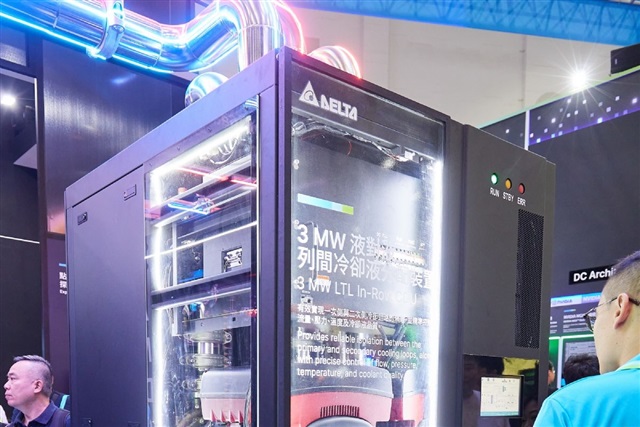
Delta Electronics and Lite-On lifting capex toward 9% of revenue signals a structural shift: the choke point in AI infrastructure is migrating from compute to the systems that feed and cool it. When Nvidia and AMD compress their platform cadence to roughly a year, and each generation lifts rack power density into ranges that make air cooling untenable, power-supply and liquid-cooling vendors are forced into a capex profile that used to belong only to fabs and hyperscalers. That is a warning to investors treating these firms as low-multiple industrial suppliers.
The global read-through is sharper when paired with the Oracle gas-pipeline slip and forecasts of climbing fuel costs for hyperscalers. Two separate constraints are converging on the same conclusion. Upstream, the grid and fuel supply cap how much AI capacity can physically come online. Downstream, thermal engineering caps how densely that capacity can be packed. Between them sits a narrow class of power and cooling specialists who now hold genuine pricing power. Design-cycle lock-in matters here: a supplier that misses one platform generation may be locked out for years, so the capex race is really a race to stay inside the qualified vendor list. Expect consolidation, long-term supply agreements resembling chip allocation deals, and margin expansion for whoever can scale liquid cooling fastest.
For Japan, this is both exposure and opening. Japanese power-electronics and precision-cooling engineering has deep competence in exactly the components this cycle rewards, and the weak yen makes their manufacturing base attractive for export-oriented buildout. The risk is cadence: Japanese suppliers historically optimize for reliability and long qualification cycles, which clashes with an annual refresh rhythm that punishes slow R&D. Firms that cannot compress their design-to-production loop will cede share to Taiwanese rivals moving at hyperscaler speed.
For domestic data center operators and the SIers building them, the planning implication is immediate. Facility designs premised on air cooling and conventional power provisioning will be obsolete before the buildings open. SIers should be pricing liquid-cooling retrofits, higher-amperage distribution, and power-availability clauses into every AI infrastructure proposal now, not treating them as later upgrades. Power procurement, not GPU procurement, is becoming the gating item in Japanese AI project timelines. The competitive edge will belong to integrators who can navigate grid interconnection and thermal design as a single system rather than outsourcing both to vendors.