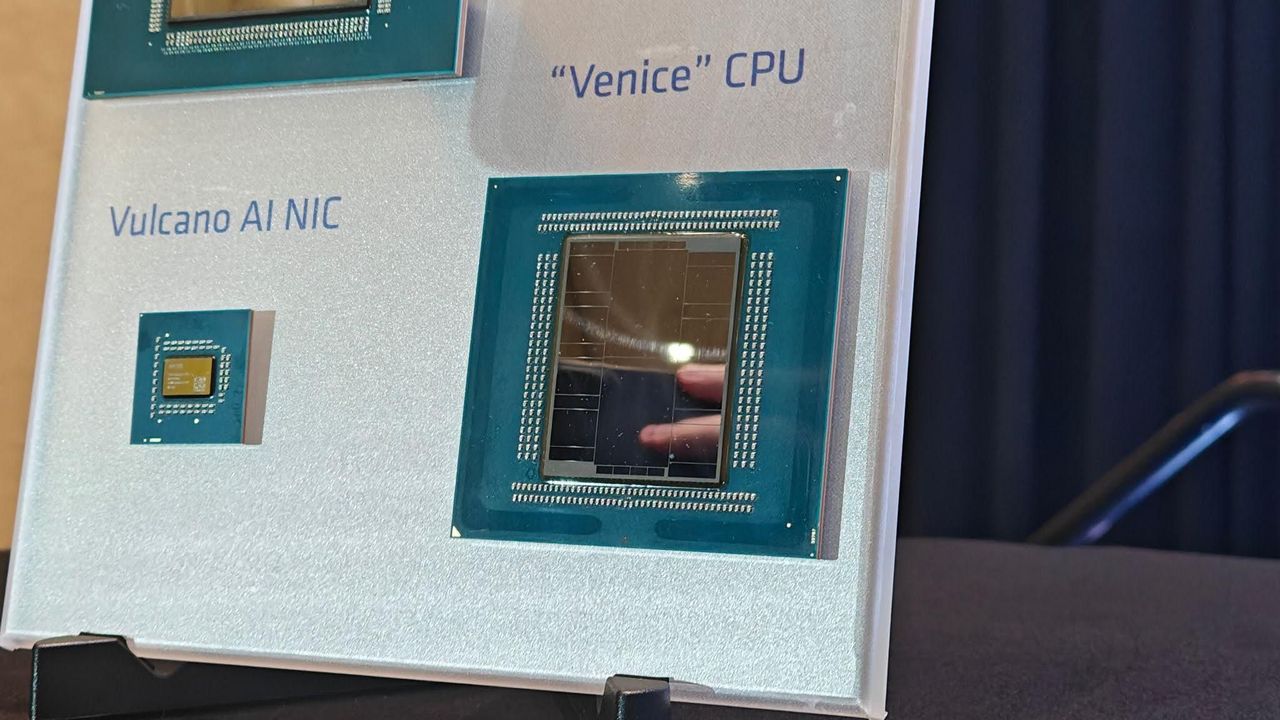
AMD has published its first official EPYC 'Venice' numbers as a direct challenge to Nvidia, claiming its 256-core part is more than twice as fast as Nvidia's Vera silicon and delivers roughly 20% higher per-core performance. Strip away the marketing and the strategic message is clear: the datacenter CPU is no longer a commodity afterthought sitting next to the GPU. It is becoming a contested battleground.
The context that matters is Nvidia's move from being a pure accelerator vendor into a full-stack systems company. Vera is Nvidia's next-generation Arm-based host CPU, tightly coupled to its GPUs. By benchmarking Venice against it directly, AMD is signaling that it intends to defend the x86 host processor position inside AI racks rather than cede the entire node to Nvidia's vertically integrated design. Per-core performance claims are the tell here: AI training and inference clusters are increasingly bottlenecked on data movement and orchestration, not just raw FLOPS, so the CPU that feeds the accelerators carries real economic weight. Vendor-supplied benchmarks always deserve skepticism until independent testing lands, but the framing reveals where AMD believes the margin pool is shifting.
For the broader industry, this intensifies a three-way squeeze. Nvidia wants to own the node end to end, AMD wants to keep x86 relevant as the host, and Arm-based custom silicon from hyperscalers keeps eroding both. The winner is whoever offers the best performance-per-watt-per-dollar at rack scale, because power and cooling now dominate total cost of ownership.
For the Japanese market, the implications run through infrastructure economics. Domestic cloud and telecom operators building sovereign AI capacity, along with the SIers designing and integrating those environments, gain negotiating leverage when AMD and Nvidia compete head-to-head on the host CPU. More competition at the CPU layer means better pricing and less lock-in for the enterprises these integrators serve. It also complicates procurement: SIers can no longer treat the host processor as a default line item, and will need to model workload-specific performance and power draw rather than defaulting to a single vendor stack.
There is also a strategic angle for Japan's own silicon ambitions. The Arm heritage that underpins domestic HPC efforts sits in the same architectural lane Nvidia is now pushing commercially, while x86 remains the incumbent in most enterprise datacenters. Japanese firms planning multi-year AI infrastructure investments should treat the host-CPU layer as an active decision, not a given, and build vendor flexibility into their designs. The teams that benchmark against their actual workloads, rather than trusting headline claims, will extract the most value as this contest plays out.