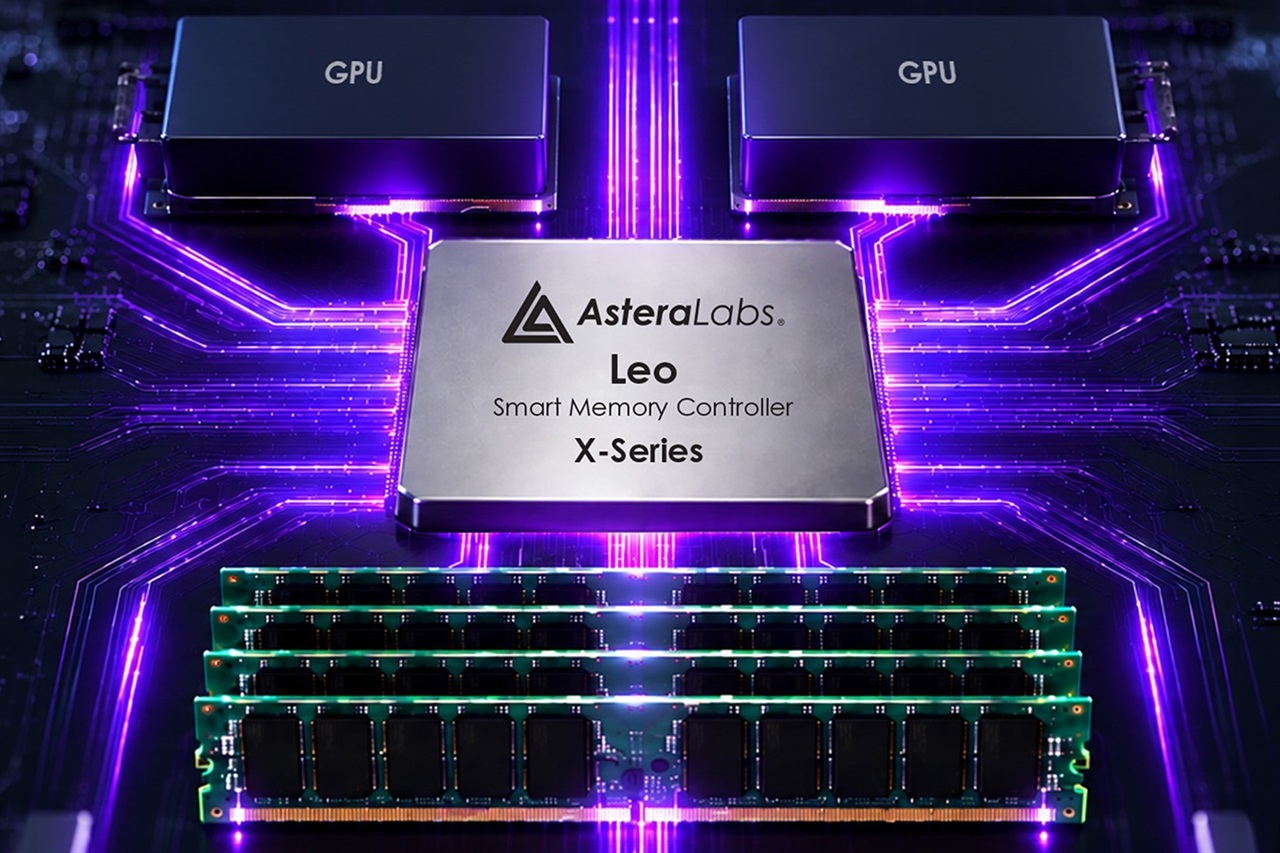
Astera Labs expanded its Leo memory controller line to address a problem that sharpens as AI moves from single queries to agents running continuous loops: the key-value cache outgrows the HBM sitting on the accelerator, and the usual fallback only makes latency worse.
For two years the industry has measured AI progress in GPU FLOPS. Agentic workloads quietly rewrite that math. An agent that reasons across long contexts, calls tools, and maintains state over many turns keeps a growing KV cache resident in high-bandwidth memory. HBM is the scarcest, most expensive resource in the stack, and when the cache overflows, systems spill to slower memory and watch throughput collapse. The binding constraint is shifting from how fast a chip can compute to how efficiently the memory hierarchy can hold and move state. That is why controller and interconnect players are suddenly strategic rather than plumbing.
The commercial consequence is a reordering of where value accrues. If memory capacity and bandwidth, not peak compute, gate inference economics, then the cost of serving an agent becomes a function of memory orchestration as much as GPU count. Cloud providers gain a lever to cut cost-per-agent without buying more accelerators, and the tiered-memory approach (offloading cache to cheaper pools while preserving latency) becomes a design pattern every inference platform will need. It also pressures the assumption that more silicon is always the answer.
For Japanese enterprises and SIers, this lands squarely on total cost of ownership. Japanese firms deploying AI tend to be cost-sensitive and cautious about runaway cloud bills, and agentic inference is precisely where those bills balloon unpredictably. SIers advising on on-prem versus cloud inference should treat memory architecture, not just GPU procurement, as a first-order design decision. The teams that understand cache behavior and memory tiering will quote sustainable per-agent economics; those that size systems by GPU alone will be surprised by the runtime bill.
There is also a supply-chain read for Japan's memory heritage. As inference demand tilts toward memory capacity and smarter controllers, Japanese component and storage players sit closer to the value than the GPU-centric narrative implied. For domestic RPA and automation vendors migrating from rule-based bots to agentic workflows, the lesson is blunt: the differentiator will be running agents affordably at scale, and that is now a memory problem as much as a model problem.