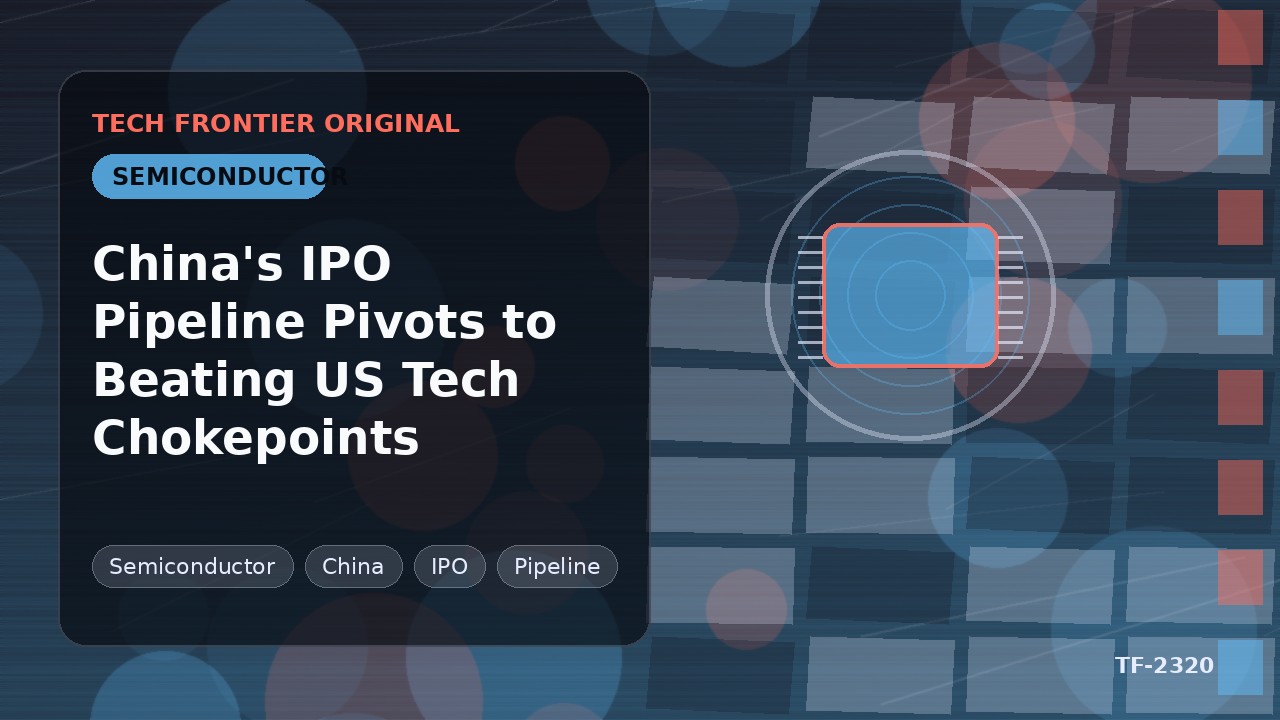
Export controls were designed to slow China down. Instead, they are functioning as an industrial policy signal, telling founders and state-linked capital exactly where the returns and the political backing lie. When roughly 20% of this year's Star Market IPOs cluster around chokepoint technologies, up from 8.1% two years ago, that is not organic market demand. It is a state-directed reallocation of listing slots, subsidies, and talent toward the specific gaps Washington created. Restriction has become a targeting mechanism.
The global implication is that the US is buying time, not a durable moat. Cutting off advanced lithography, EDA tools, and high-end GPUs raises China's near-term costs and delays leading-edge nodes, but it also guarantees a domestic buyer for every credible local substitute. Over a five-to-ten-year horizon, that produces a parallel supply chain optimized for the mature and trailing-edge nodes that actually run most industrial, automotive, and appliance electronics. Western toolmakers and IP vendors face a slow erosion of their largest single market, while gaining a subsidized competitor at the low and middle end.
For Japan, this is the more uncomfortable side of the story. Japanese firms dominate critical layers of the semiconductor equipment and materials stack, from deposition and etch systems to photoresists and specialty chemicals. China's chokepoint push is explicitly aimed at these dependencies. In the short run, Japanese suppliers benefit from urgent Chinese buying ahead of tighter controls, but that revenue is being reinvested by customers into replacing them. The strategic risk is a repeat of the display and solar playbooks, where Japanese technical leadership was gradually commoditized by scaled domestic Chinese rivals.
Japanese enterprises and SIers should treat this as a supply-chain design problem, not a geopolitics headline. Procurement teams need scenario planning for a bifurcated component world, where products destined for China increasingly require China-origin chips and tooling to remain saleable, while Western-facing lines follow separate sourcing rules. That dual-track reality raises BOM complexity, compliance overhead, and inventory cost.
For SIers and domestic development teams, the opportunity is concrete: export-control compliance tooling, component traceability systems, and supply-chain risk platforms are becoming board-level requirements for Japanese manufacturers. RPA and workflow automation around trade classification, license screening, and vendor-origin auditing is unglamorous but sticky work. The firms that build this compliance layer now will hold defensible positions as fragmentation deepens.