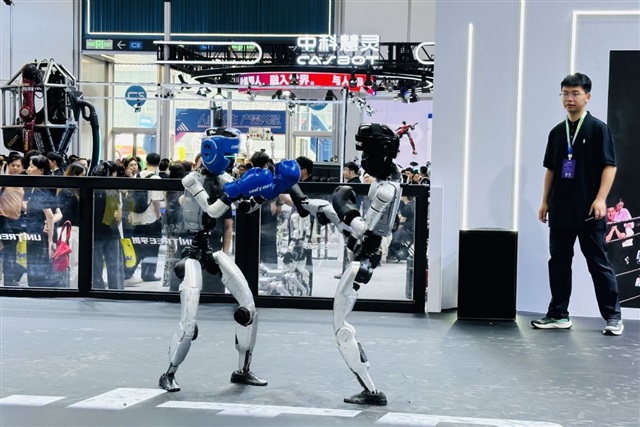
The underlying fact is narrow: Novosense, a Chinese analog and mixed-signal chipmaker, launched the NSM350x, a Hall-based magnetic encoder for high-precision angular measurement in robot joints and industrial motion-control systems.
The strategic weight is anything but narrow. Angular encoders are the proprioception of a robot — without accurate joint-angle feedback, torque control, gait balance, and repeatable positioning all degrade. As the embodied-AI thesis draws capital into humanoids and next-generation factory automation, the bottleneck shifts from models to the mechatronic bill of materials: actuators, reducers, drivers, and precisely the sensing layer this chip addresses. China localizing that layer does two things at once. It compresses the cost curve for domestic robot builders chasing volume, and it erodes the pricing power of the incumbents who have quietly earned high margins on unglamorous components. Expect the same playbook that reshaped power electronics and lidar: aggressive domestic adoption first, export pressure second, margin compression across the category third.
For the wider industry, the signal is that China's chip-independence drive is moving past logic and memory into the sensor and motion-control periphery, where supply has been concentrated and switching costs assumed to be sticky. Robot OEMs anywhere optimizing landed cost will eventually qualify these parts, which reprices the entire component stack even for firms that never buy them.
This is where Japan has the most to lose and the most institutional advantage. Motion control — servos, harmonic reducers, high-resolution encoders — is a genuine Japanese stronghold, tied to decades of factory-automation and robotics leadership. A credible Chinese encoder does not displace that overnight; precision, drift stability, and field reliability are earned over years of deployment. But it does attack the volume, cost-sensitive tier where the humanoid wave will actually scale, and that is the tier where Japanese suppliers are most exposed to being designed out. The defensive move is to compete up the stack: integrated sensing-plus-control modules, functional-safety certification, and reliability data that a commodity part cannot match.
For Japanese SIers and manufacturing-line integrators, the near-term implication is procurement, not panic. As lower-cost sensing enters robot platforms, integrators should treat encoder sourcing as a qualification and validation problem — building test regimes for accuracy and long-term drift rather than defaulting to legacy vendors. The teams that build that evaluation capability now will hold the leverage as the component map redraws.