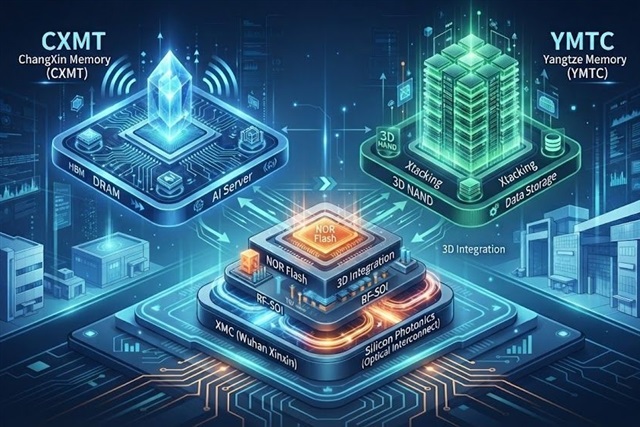
The underlying shift is structural, not cosmetic. China is moving from betting on one national memory champion to fielding three specialists: CXMT anchoring DRAM, YMTC pushing 3D NAND, and XMC pivoting toward NOR Flash, 3D integration and optoelectronics.
The strategic logic is portfolio diversification under sanctions pressure. A single flagship is a single point of failure—one entity list addition can freeze an entire product category. By distributing capability across three firms with distinct process focuses, Beijing hedges against targeted export controls and builds redundancy into its most import-dependent semiconductor segment. XMC's tilt toward NOR and optoelectronics is the most telling move: rather than fight head-on in the most restricted leading-edge tooling, it colonizes adjacent, less-contested niches where domestic demand is real and Western incumbents are complacent.
Globally, the near-term threat is not the high-end datacenter tier but the commodity floor. DRAM and NAND are cyclical, margin-thin businesses, and a state-backed supplier optimizing for capacity rather than return can compress pricing across legacy nodes. That squeezes the low end first—the exact territory where established players earn their volume. Expect the competitive front to be price and availability in mature memory, not a raw performance race.
For Japan, the exposure runs two ways. Kioxia sits directly in YMTC's path in NAND, and any Chinese oversupply in commodity flash pressures the pricing that underpins its balance sheet and investment cadence. But the deeper story is upstream: Japanese equipment and materials suppliers—photoresists, deposition and etch tools, test systems, silicon wafers—are woven into every one of these three fabs. Three fabs scaling in parallel means more short-term order flow, but also sharper strategic risk if Tokyo tightens export rules in step with Washington. Japanese suppliers now face a familiar bind: today's revenue versus tomorrow's regulatory exposure.
For Japanese SIers and enterprise buyers, the practical read is supply-chain planning. A more diversified Chinese memory base could ease commodity DRAM and NAND availability for server and edge builds over the medium term, but it also injects geopolitical volatility into procurement. Firms specifying long-lived infrastructure should assume memory sourcing becomes a policy-sensitive decision, not a purely commercial one, and build dual-sourcing assumptions into hardware roadmaps accordingly.