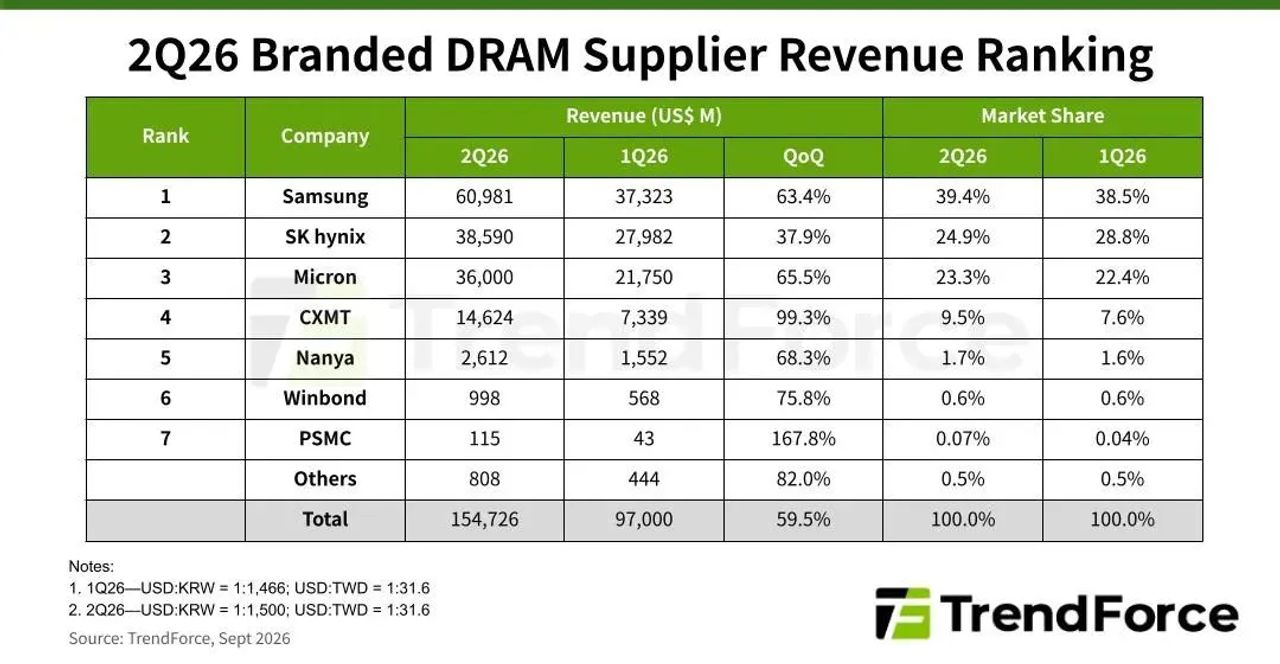
The headline number is stark: DRAM contract prices rose 59.5% quarter-on-quarter in Q2, lifting segment revenue toward $154.73 billion while supplier inventories sit at historic lows, per TrendForce. The mechanics behind that spike matter more than the figure itself.
This is not a classic memory cycle. In prior upswings, price recovery followed demand normalization after a glut. This time, HBM and server-grade DRAM tied to AI accelerator platforms are absorbing wafer capacity that would otherwise feed commodity DDR5, structurally starving the broader market. When suppliers allocate incremental output to the highest-margin AI buyers, everyone else competes for a shrinking residual pool. The result is a demand shock layered on a deliberate supply reallocation, which is why depleted inventories are not translating into aggressive restocking discounts.
The global implication for buyers is a durable cost-floor reset. Hyperscalers can pass memory inflation into cloud pricing, but system builders, PC and handset OEMs, and edge-hardware vendors face compressed margins or forced price increases into 2026. Anyone budgeting server refreshes or on-prem AI infrastructure on 2024 memory economics is now working from stale numbers. Procurement leverage has shifted decisively to the sellers.
For Japan, the exposure runs in both directions. The country hosts real memory capacity through Micron's Hiroshima operations and Kioxia's NAND base, so a tight, high-priced market supports domestic manufacturing investment and the broader Rapidus-era push for supply resilience. But the buy side is where most Japanese enterprises live. Hardware-heavy SIers running large system-integration contracts on fixed-price terms will feel margin erosion as server BOM costs climb mid-project, particularly on multi-year public-sector and financial deals signed before this run-up.
The strategic takeaway for Japanese IT leaders and SIers is to treat memory as a volatile commodity input, not a stable line item. That means building price-escalation clauses into integration contracts, front-loading procurement where roadmaps allow, and accelerating the shift of compute-heavy AI workloads to cloud where the memory-cost risk is borne by the provider. For on-prem RPA and internal AI pilots, the calculus now favors right-sizing hardware and validating that a workload genuinely needs local silicon before committing capital at today's inflated component prices.