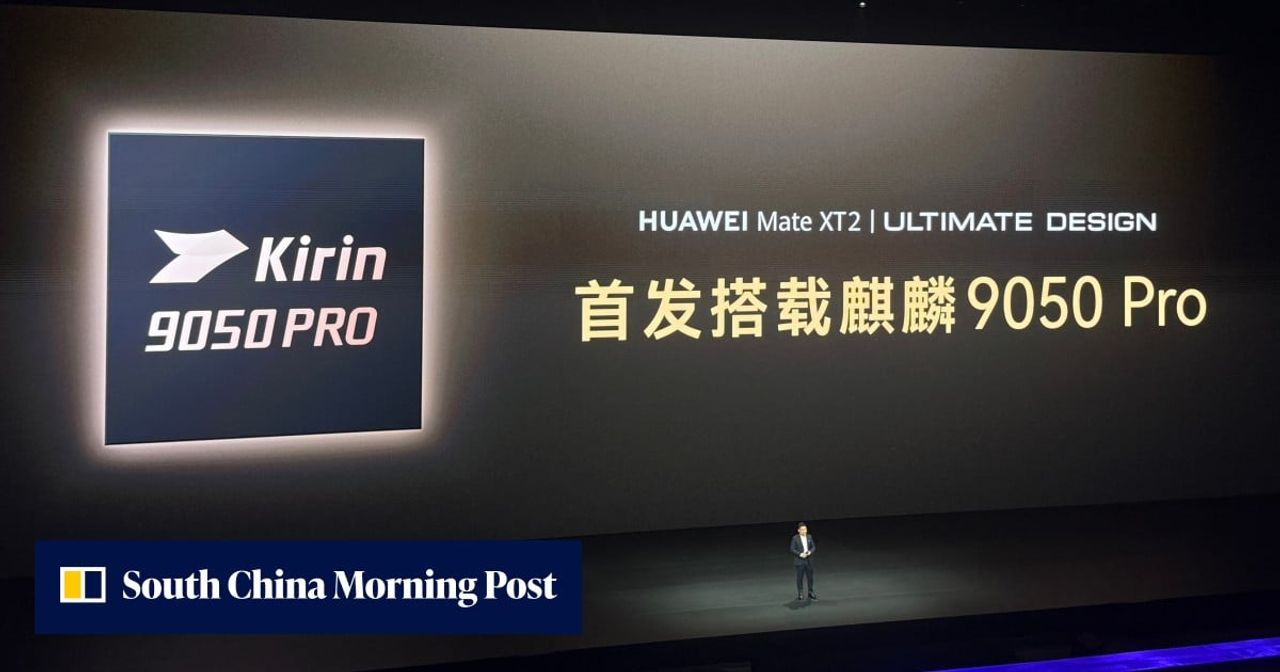
Huawei's Kirin 9050 Pro is the first commercial silicon built on its LogicFolding architecture, a design that stacks circuitry vertically to extract more performance without relying on the finest process nodes. The strategic message is bigger than one phone: it is a proof point for whether engineering creativity can offset the tools China cannot legally buy.
Denied EUV lithography, Huawei and its foundry partners are stuck at mature nodes where transistor density gains are slow and expensive. LogicFolding reframes the problem. Instead of chasing horizontal shrink, the bet is on vertical integration—more logic in the same footprint through 3D stacking and advanced packaging. If it holds up on yield and thermals, it signals that the industry's decades-long obsession with node numbers is only one axis of competition, and that packaging is becoming the new battleground.
The caveats are real. Stacking raises heat density, complicates power delivery, and can hurt yields, which pushes cost per working die higher. A flagship phone can absorb premium economics; data-center AI accelerators, where Huawei's 'bigger ambitions' clearly point, are far less forgiving. The open question is whether LogicFolding scales from a handset SoC to the high-throughput parts that would loosen Nvidia's grip inside China.
For Japan, this plays directly to a structural strength. The country dominates several links in the advanced-packaging chain—bonding equipment, photoresists, specialty chemicals, and substrate materials. A global pivot toward 3D stacking increases demand for exactly what Japanese suppliers make, and the more chipmakers everywhere lean on packaging to compensate for lithography limits, the more that materials-and-tools layer captures value. Rapidus and Japan's 2nm push get the headlines, but the packaging ecosystem may be the quieter, more durable win.
For Japanese SIers and enterprise IT teams, the near-term takeaway is supply-chain and procurement risk, not architecture. A viable domestic Chinese compute stack changes device sourcing, export-control exposure, and the calculus for firms operating across both markets. Development teams building for AI infrastructure should assume a more fragmented hardware landscape—multiple accelerator families, divergent toolchains—and design for portability rather than betting on a single vendor's roadmap.