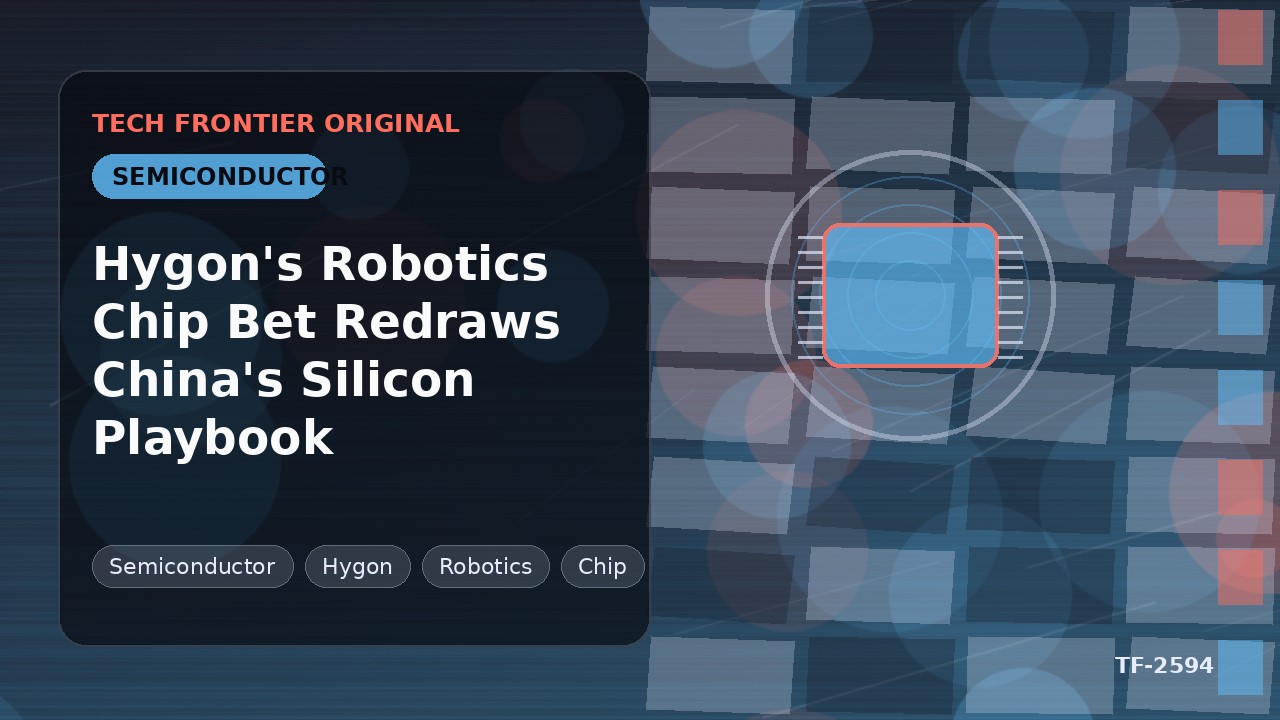
Hygon's step from datacenter silicon into chips built for robotics and other embodied systems is less a product footnote than a strategic pivot. Datacenter CPUs and accelerators are a saturating, capital-intensive arena where Chinese firms remain boxed in by US export controls and a maturing Nvidia-dominated software moat. Physical AI, the layer where models perceive and act in the real world, is comparatively greenfield. Whoever supplies the low-power, real-time compute for robots, autonomous machines, and industrial actuators gets to define an architecture before a global standard hardens. Hygon is trying to open a second front rather than keep grinding against an entrenched incumbent.
The global read is that China is treating robotics as the natural landing zone for a semiconductor policy that cannot win the frontier-GPU race outright. Domestic robot and EV volume gives Chinese chipmakers a captive demand base that Western rivals cannot easily replicate, and edge inference silicon sidesteps some of the bleeding-edge process-node constraints that hobble datacenter ambitions. The risk is fragmentation: a bifurcated ecosystem where robotics platforms built on Chinese silicon and toolchains diverge from Nvidia Jetson and Qualcomm-based stacks elsewhere, forcing multinationals to maintain parallel hardware lines.
For Japan, this cuts close to a core franchise. Japanese firms still lead in industrial robotics arms, motion control, and factory automation, but the intelligence layer is shifting from mechanical precision to onboard AI compute. If Chinese suppliers commoditize the perception-and-control chip, the value in a robot migrates toward silicon and software where Japan is thinner. Japanese robotics vendors and their component suppliers should treat embedded-AI compute as a strategic sourcing decision, not a bolt-on, and decide deliberately between building capability, partnering, or hedging across US and Chinese platforms.
For SIers and enterprise integrators, the implication is that automation projects will increasingly require silicon-level architecture choices with geopolitical baggage attached. An RPA-and-factory-automation practice that once cared only about software layers now inherits questions about chip provenance, export exposure, and long-term supply continuity. SIers that build genuine edge-AI and physical-automation integration skills, rather than reselling black-box platforms, will capture the margin as Japanese manufacturers modernize plants under labor-shortage pressure.
The near-term signal to watch is toolchain lock-in. Hardware rarely wins on specs alone; it wins when developers standardize on its SDKs and reference designs. Japanese decision-makers evaluating automation roadmaps should weight ecosystem maturity and multi-vendor portability heavily, and avoid committing critical production lines to any single-origin stack before the standards fight settles.