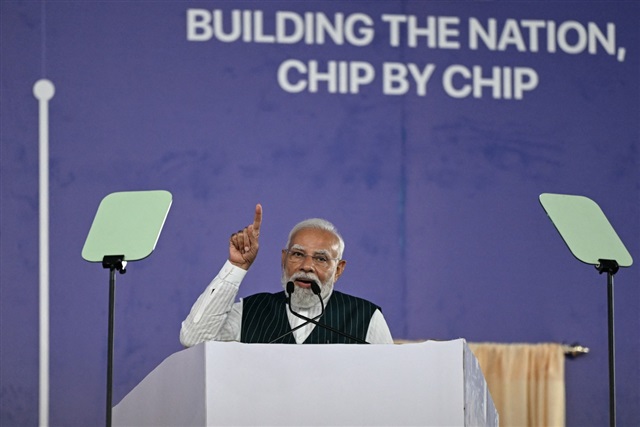
The underlying signal is straightforward: Indian semiconductor companies have raised close to half of their all-time equity funding since the start of 2025, with deal volume peaking just as SEMICON India 2026 opens in New Delhi. Pair that with Tata Consultancy Services' roughly $7.4 billion commitment to a one-gigawatt AI data center in southern India, and the picture is no longer about isolated fab announcements. It is about a country trying to compress the entire stack, from design and packaging to the power-hungry compute that consumes those chips, into a single national industrial thesis.
Globally, this matters because capital is voting for geographic redundancy. Investors backing India are not betting it out-fabricates Taiwan this decade. They are pricing in the premium that governments and hyperscalers will pay for a credible third pole between a saturated Taiwan-Korea axis and an increasingly walled-off China. The gigawatt data center is the tell: you do not build that scale of AI compute speculatively. It implies anchored demand, likely sovereign and enterprise workloads that want to stay onshore. India is positioning as both a fabrication aspirant and a compute consumer, and the second role is far easier to win quickly.
The risk is timing mismatch. Funding surges and conference momentum run ahead of yield-qualified capacity, skilled fab labor, and stable power. India can stand up data centers faster than it can stand up leading-edge fabs, so the near-term reality is a compute buildout leaning on imported silicon, not domestic wafers. That gap is the honest caveat behind the headline enthusiasm.
For Japan, there are two distinct pressures. On silicon, Japan's revival strategy centers on advanced-node manufacturing and materials-and-equipment strength; India's push is complementary rather than directly competitive at the leading edge, but it fragments the pool of government subsidies, engineering talent, and equipment orders that Japanese suppliers hoped to concentrate. On services, the sharper threat lands on SIers. TCS building gigawatt-scale AI infrastructure at home strengthens the Indian IT majors precisely as they move up-stack into AI platform delivery, the same higher-margin territory Japanese SIers are targeting to escape labor-intensive contract work.
Japanese enterprises and their integration partners should treat this as a sourcing and partnership question, not a spectator event. India becomes a viable node for AI workload placement, engineering capacity, and China-plus-one supply diversification. Domestic SIers and RPA-heavy shops that still sell headcount will find Indian rivals arriving with owned compute and platform IP. The defensible move for Japanese teams is to lock in the parts of the stack India cannot easily replicate near-term: regulated-industry domain depth, data-sovereignty-sensitive delivery, and the materials and equipment expertise where Japan retains a structural edge.