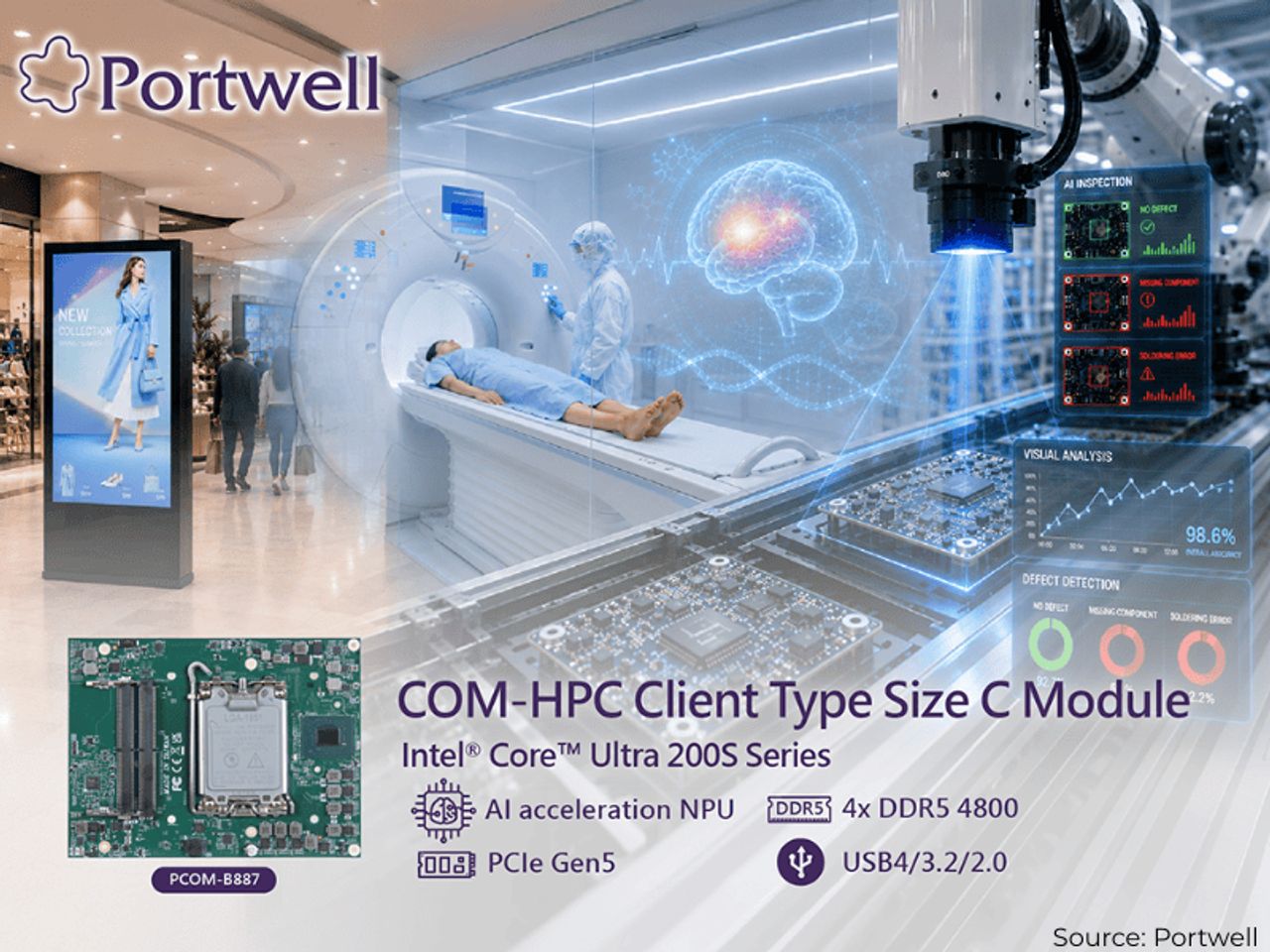
Portwell's PCOM-B887 pairs Intel's Core Ultra 200S silicon with integrated CPU, GPU and NPU on a COM-HPC module aimed at industrial, medical and machine-vision systems. The specifics matter less than the pattern they confirm: AI inference is migrating out of the data center and onto the machine.
The strategic story here is modularity. COM-HPC lets an OEM swap the compute engine without redesigning the carrier board or the surrounding system. That decouples the AI upgrade cycle from the product lifecycle, which is exactly what industrial buyers need when model requirements shift faster than capital equipment depreciates. For Intel, the edge is a defensible position that Nvidia's data-center strategy does not fully cover, and a built-in NPU lets it compete on inference-per-watt rather than raw throughput. The broader implication is a bifurcation of the AI compute market: hyperscale training remains a GPU arms race, while a fragmented, standards-driven edge layer rewards integration, thermal efficiency, and long-term supply commitments.
For Japan, this lands directly in the country's industrial core. Factory automation, machine vision, and precision medical equipment are domains where Japanese firms hold genuine global position, and all three are converging on local AI inference for defect detection, predictive maintenance, and real-time control. A structural labor shortage and an aging workforce make automation non-negotiable rather than optional, which strengthens the pull toward smarter edge devices.
The opportunity for Japanese SIers is to move up from integrating fixed-function controllers toward delivering AI-enabled edge systems as a managed capability. That is a harder sell than legacy RPA, which automated screens and back-office workflows; the frontier now is physical, sensor-driven automation where latency, safety, and reliability dominate. SIers that build MLOps and model-update pipelines for deployed edge fleets can capture recurring revenue instead of one-off system delivery.
The risk is dependency. Standardized modules commoditize the hardware layer and shift value to software and integration know-how. Japanese vendors that treat these boards as drop-in components will compete on price; those that own the model lifecycle and domain data will own the margin. The decision to make this year is where in that stack to invest.