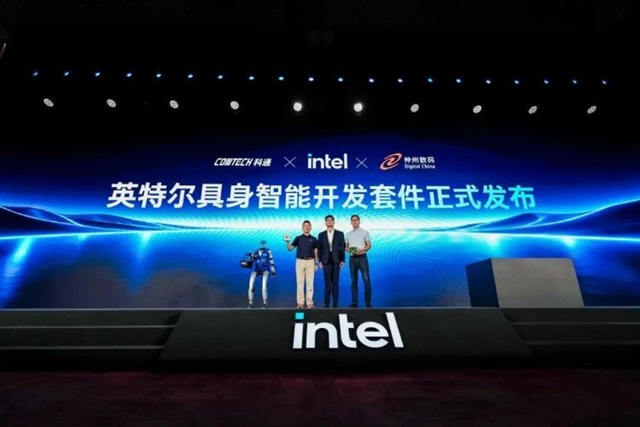
Intel staging a China ecosystem conference around edge AI, enterprise AI, and physical AI—and pairing it with an economist framing the AI revolution as a development story—is less a product event than a positioning maneuver. Intel has effectively conceded the frontier-training market to Nvidia. What remains is the vast, unglamorous layer beneath it: inference at the edge, on-premise enterprise deployment, and AI embedded in factories and machines. That is where x86, existing OEM relationships, and mature toolchains still carry weight, and where Intel can plausibly compete without a defensible GPU story.
The China angle sharpens the logic. Export controls have thinned the supply of high-end accelerators, which paradoxically makes edge and inference silicon more strategically valuable inside the country—Chinese enterprises need AI capacity they can actually procure and localize. Intel is positioning itself as the pragmatic option for the deployment layer rather than the training layer, and bringing in a development economist reframes AI adoption as national productivity policy rather than a vendor pitch. It is a smart read of a constrained market, though it also underscores how much of Intel's China opportunity is defined by what it can no longer sell there.
The broader signal for global executives: the AI value chain is bifurcating. Training economics concentrate around a few hyperscalers and Nvidia; inference and physical AI diffuse across thousands of endpoints, factories, and enterprise racks. The second market is larger by unit volume and stickier by integration, and it rewards incumbency in silicon, drivers, and industrial partnerships over raw peak performance. Intel is betting its future relevance lives there.
For Japanese enterprises and SIers, this bifurcation is the more actionable story than any single Intel event. Japan's manufacturing base, keiretsu supply chains, and factory-floor automation make it a natural market for exactly the physical-AI and edge-inference layer Intel is courting. Japanese firms are unlikely to build frontier models; they will consume inference at the edge—in production lines, logistics, and quality inspection—where x86 servers, industrial PCs, and on-prem deployment already dominate. SIers like NT Data, NRI, and the manufacturing-integration arms of Fujitsu and Hitachi should read edge AI not as a hardware refresh but as a services opportunity: integrating inference into OT environments, retrofitting legacy factory systems, and managing the data-locality and reliability constraints that Japanese clients prize.
The RPA and enterprise-dev implication follows directly. As inference moves on-prem and to the edge, the automation conversation shifts from screen-scraping bots toward AI-augmented physical and process automation—vision-based inspection, agentic workflows running on local hardware, and hybrid architectures where sensitive data never leaves the plant. Japanese development teams that build durable edge-inference and integration muscle now will capture the deployment layer that Intel and its rivals are fighting to supply. The teams that wait for a single dominant frontier model to solve everything will find the value has already settled into the messy, integration-heavy layer where Japan's engineering culture is strongest.