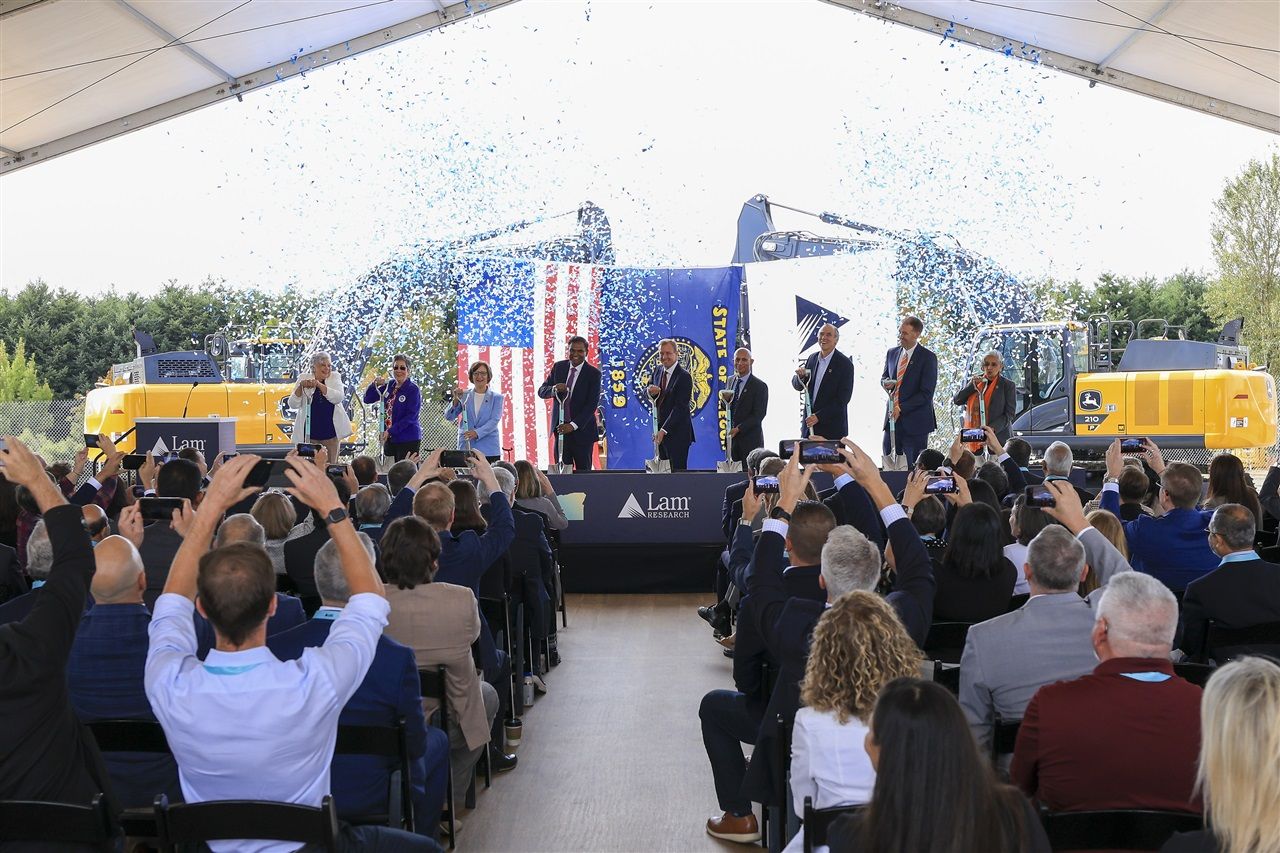
Lam Research has broken ground on a new Oregon research facility, part of a global investment exceeding $3 billion aimed at accelerating advanced AI chip development.
The strategic signal here is bigger than one building. The AI narrative has fixated on GPUs and foundries, but the real constraint sits upstream, in the wafer-fab equipment (WFE) layer where a handful of firms control the etch, deposition, and cleaning steps that make leading-edge logic and high-bandwidth memory physically possible. By pouring capital into R&D rather than just capacity, Lam is betting that the next competitive frontier is process innovation for gate-all-around transistors, advanced 3D structures, and the increasingly exotic packaging that stacks HBM beside compute dies. Whoever masters those steps first sets the pace for everyone downstream, from TSMC to the hyperscalers designing custom silicon.
This also hardens a structural reality: WFE is a durable oligopoly with high switching costs. As nodes get harder and yields more capricious, chipmakers grow more dependent on the toolmakers' process knowledge, not less. That dependency is precisely why equipment R&D spending is a leading indicator worth watching—it front-runs capacity announcements by years.
For Japan, this is not a spectator story. The country holds commanding positions in adjacent choke points—Tokyo Electron in deposition and coating, Screen and Kokusai in specialized process steps, plus materials dominance through Shin-Etsu, SUMCO, and JSR in wafers and photoresists. Lam's escalation pressures Japanese toolmakers to match R&D intensity or risk ceding the most profitable process segments. It also intersects with Rapidus, the state-backed 2nm venture in Hokkaido, whose viability depends on securing precisely the kind of advanced tooling and process partnerships this investment wave is racing to define.
For Japanese enterprise IT and SIers, the second-order effect matters more than the tooling itself: if leading-edge equipment R&D accelerates, the cost curve for AI compute bends favorably over the medium term, but supply timing stays volatile. Firms planning on-prem AI clusters or GPU-heavy workloads should treat hardware availability as a strategic variable, not a procurement afterthought, and hedge with cloud capacity where lead times are unpredictable.