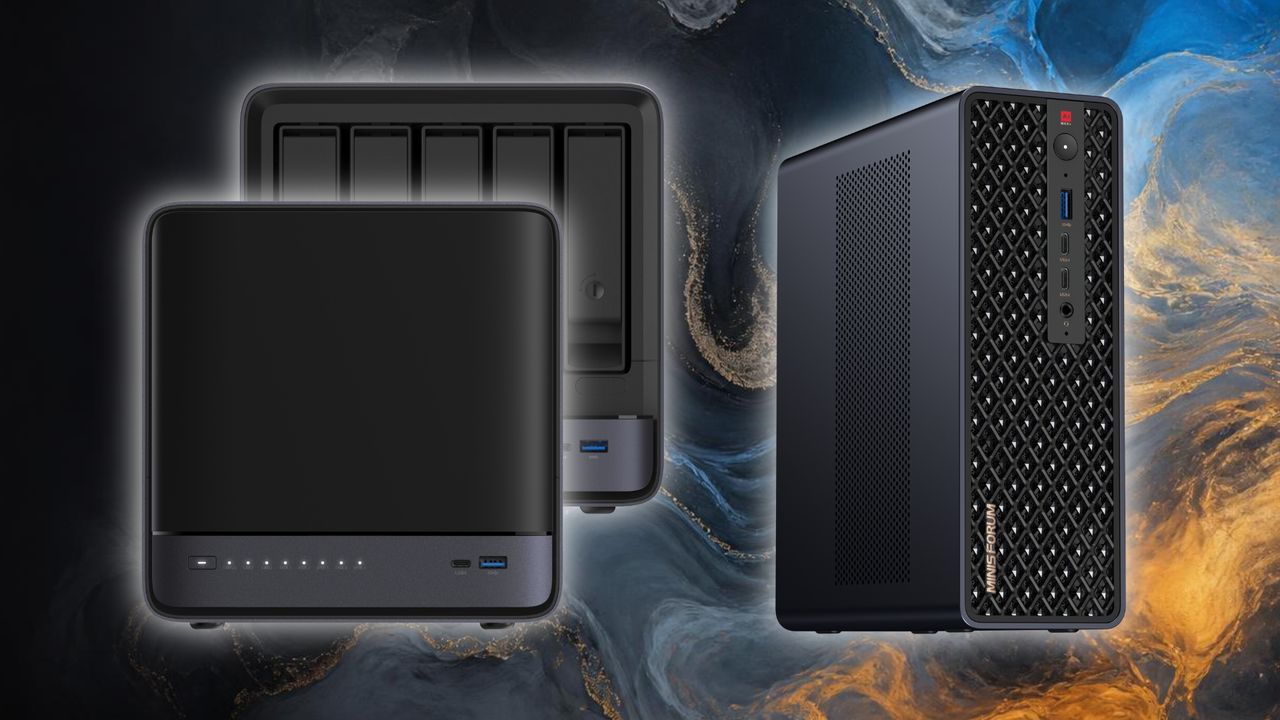
Minisforum's IFA 2026 lineup—a NAS and a mini-workstation built on AMD's Ryzen AI Max+ Pro 495 with up to 192GB of unified memory and a Radeon 8065S integrated GPU—matters less as a product than as a market signal. Unified memory at this capacity lets a desktop-class box hold mid-sized models entirely in fast, shared RAM, sidestepping the discrete-GPU VRAM ceiling that has kept serious local inference out of reach. The strategic story is that the floor for private AI is dropping fast, and it is AMD, not Nvidia, pushing the price-per-token wedge at the edge.
Globally, this pressures two assumptions. First, the belief that all inference gravitates to hyperscale clouds: when a fixed-cost appliance can run a 70B-class model for a small team, the recurring-token bill starts looking like rent you did not need to pay. Second, the framing that AI capability is gated by frontier models alone. For a large share of real workloads—retrieval, summarization, code assist, document processing—a good open-weight model on local silicon is sufficient, and the marginal cost of an extra query approaches zero. That reshapes vendor lock-in dynamics and gives buyers real leverage in cloud negotiations.
For Japan, the fit is unusually strong. Japanese enterprises, especially in finance, manufacturing, healthcare, and the public sector, carry deep-rooted preferences for on-premises deployment and data residency, and many remain wary of shipping proprietary or regulated data to overseas cloud regions. A local AI appliance answers those objections directly. Expect procurement teams to treat these boxes as a compliance-friendly path to AI adoption rather than as hobbyist hardware.
This is a clear opening for SIers. The value migrates from reselling GPUs or brokering cloud capacity toward integration work: model selection, quantization, RAG pipelines, security hardening, and lifecycle operations around on-prem inference clusters. Firms that build a repeatable 'local AI in a box' practice—with governance and monitoring baked in—can attach recurring services revenue to a one-time hardware sale. It also gives RPA vendors and legacy automation teams a credible upgrade story: swap brittle rule-based bots for local LLM-driven agents that keep sensitive data inside the client's walls.
The caution for Japanese dev teams is operational maturity. Unified memory removes a hardware bottleneck, not the need for MLOps discipline—patching, model updates, evaluation, and access control still apply. Whoever pairs this cheaper local compute with disciplined operations, rather than treating it as a plug-and-play appliance, captures the advantage.