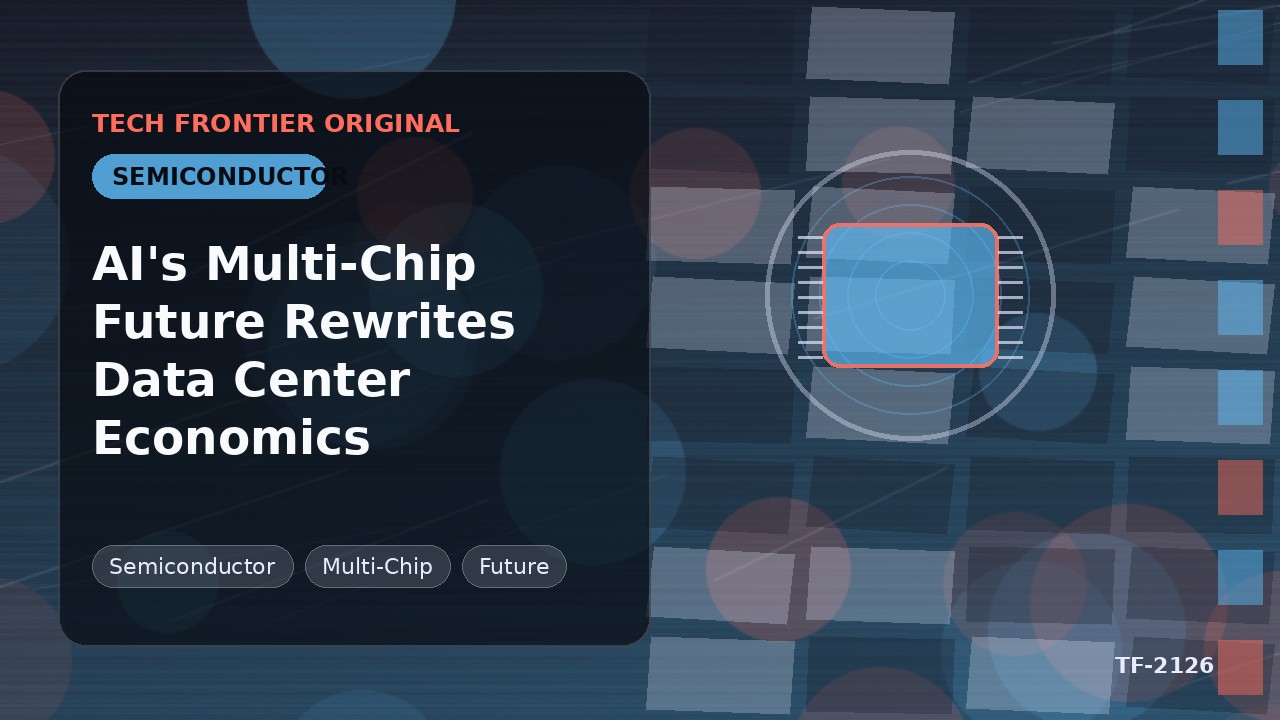
The industry's mental model of AI compute as a GPU monoculture is quietly collapsing. Power ceilings, interconnect bottlenecks, and the raw cost of serving tokens at scale are forcing operators toward mixed clusters that blend CPUs, GPUs, NPUs, optical links, and purpose-built accelerators. The strategic shift isn't about which chip wins. It's that no single chip wins, and the value migrates to whoever can schedule work across them efficiently.
Globally, this reframes the competitive landscape. Nvidia's dominance rests as much on CUDA and networking as on silicon, but a heterogeneous world rewards orchestration layers that can route a workload to the cheapest adequate processor rather than the fastest available one. That opens room for custom accelerators from hyperscalers and for optical interconnect vendors, while pressuring margins on general-purpose GPUs used for inference tasks that don't need them. The bottleneck moves from FLOPS to software that manages heat, memory bandwidth, and data movement. Expect the next round of differentiation to come from compilers, schedulers, and runtime abstraction, not peak spec sheets.
There's also a capital-allocation signal here. If inference can be spread across cheaper, more specialized silicon, the pressure to overbuild identical GPU farms eases somewhat. That matters as community and regulatory resistance to power-hungry data centers intensifies. Heterogeneity is partly an efficiency answer to a political and energy problem.
For Japan, the implications cut in two directions. Japanese enterprises and SIers have historically optimized for stable, homogeneous infrastructure and vendor-certified stacks. A heterogeneous compute era rewards the opposite skill: abstraction across incompatible hardware. SIers that build genuine capability in workload placement, model-serving optimization, and cross-accelerator tooling can move up the value chain instead of reselling GPU capacity at thin margins. Those that treat AI infrastructure as a procurement exercise will be commoditized.
Japan's domestic strengths also fit this map unusually well. The country retains real depth in power electronics, photonics, advanced packaging, and materials, all of which become more central as clusters diversify beyond logic chips. For local dev teams, the near-term lesson is practical: architect inference pipelines to be hardware-agnostic now, so that when NPUs and custom accelerators land in domestic clouds, migration is a config change rather than a rewrite. Betting on a single accelerator is becoming the riskier position.