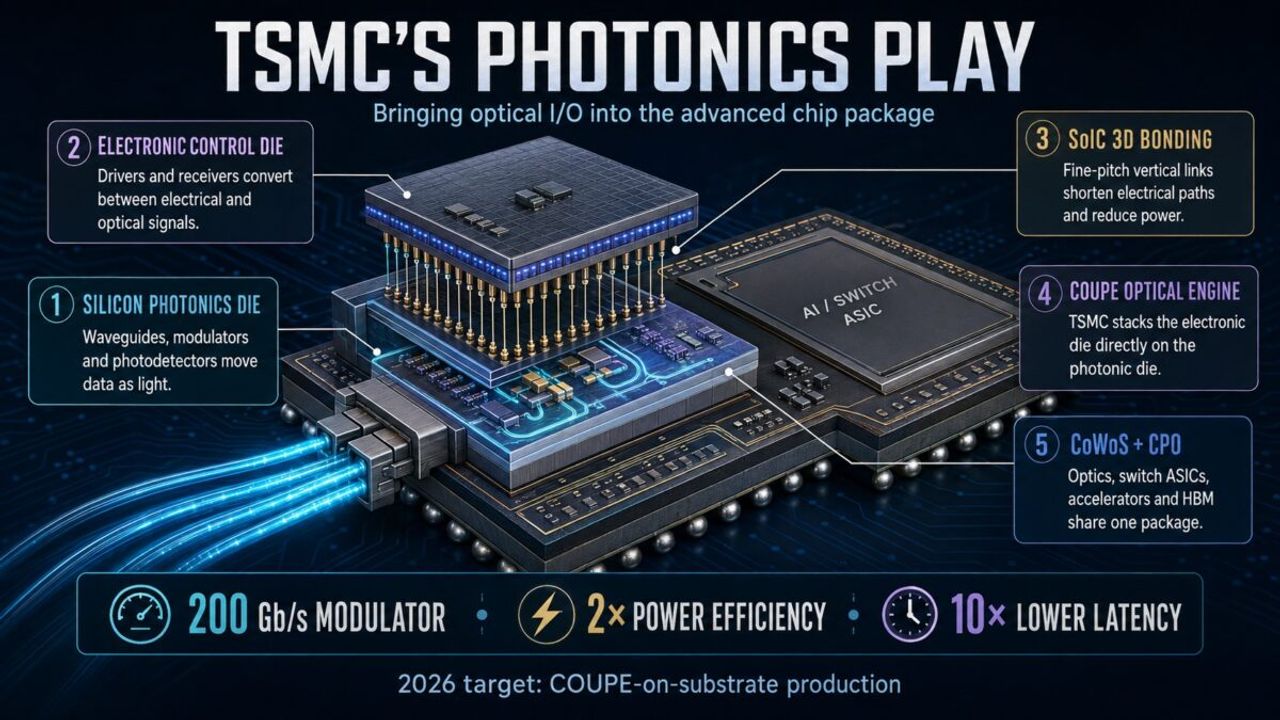
TSMC is building a silicon-photonics foundry platform and a packaging architecture, COUPE, that embeds optical input-output directly alongside advanced logic rather than shipping optics as separate transceivers. The strategic message is that light becomes part of the chip, not an accessory to it.
This lands the same week Nvidia signaled AI server prices climbing more than 15%. The two stories are the same story. As GPU clusters scale into the hundreds of thousands, the binding constraint is no longer transistor count but the energy and latency of shoveling data between accelerators. Copper interconnects are hitting a wall on reach and power draw, and every watt spent on data movement is a watt not spent on compute. By owning the optical layer at the packaging level, TSMC extends its chokehold from wafers to the interconnect fabric itself, deepening a moat that already lets it and its top customers price power. For hyperscalers, co-packaged optics is the only credible path to keep bandwidth-per-watt scaling without datacenter power budgets exploding. Expect optical I/O to migrate from exotic to mandatory in next-generation AI systems, and expect the value to concentrate further in whoever controls advanced packaging.
For Japan, this is unusually favorable positioning. Silicon photonics leans heavily on precision assembly, substrates, and test, exactly where Japanese suppliers sit. Advanced package substrates from Ibiden and Shinko Electric, dicing and grinding tools from DISCO, and high-end test systems from Advantest are structural beneficiaries as optical packaging complexity rises. NTT's IOWN and all-photonics network ambitions gain a concrete manufacturing tailwind, and materials makers across the supply chain see rising content per package.
The caution for Japanese enterprises and SIers is on the demand side. Rising AI server prices and a tightening memory market mean the cost of building or renting AI infrastructure keeps climbing. SIers architecting on-prem AI for regulated clients should model interconnect and power as first-order cost drivers, not footnotes, and treat capacity procurement as a multi-quarter planning problem rather than a spot purchase. The winners locally will be those who monetize the picks-and-shovels layer while hedging the compute-cost inflation now flowing downstream.