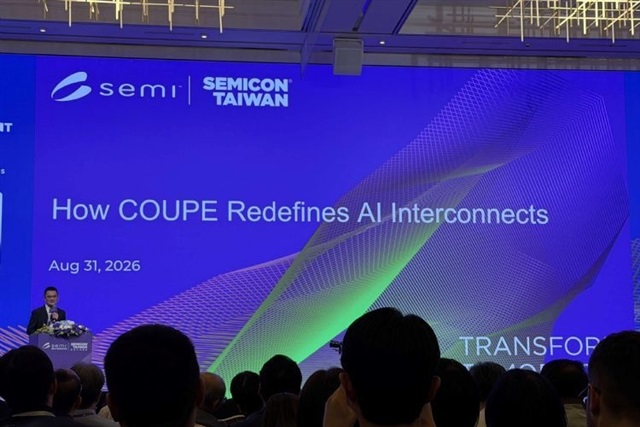
TSMC laid out two bandwidth-scaling paths for its COUPE co-packaged optics platform and a wider role for heterogeneous integration, aiming squarely at the gap between AI compute growth and chip-to-chip data movement.
The strategic signal here is bigger than any single node. For a decade the industry treated compute as the scarce resource and interconnect as plumbing. That assumption is breaking. Copper links between accelerators, switches, and memory are running into hard walls on reach, power, and bandwidth density, and every additional GPU in a training cluster makes the problem worse. By pulling optics into the package, TSMC is reframing the bottleneck: the winner of the AI buildout is increasingly whoever controls how bits move, not just how fast they are computed. That extends TSMC's leverage from wafers into packaging and now optical integration, a domain historically owned by discrete component vendors. Expect this to pressure Broadcom, Marvell, and the merchant optics ecosystem, while giving Nvidia and hyperscalers a clearer path to scale rack-level fabrics past the copper ceiling.
The economic tell is margin migration. As co-packaged optics matures, value shifts toward advanced packaging, laser sources, optical engines, and the precision materials that make them manufacturable at yield. Whoever owns those chokepoints captures durable pricing power, and TSMC positioning itself as the integrator means the substrate and materials layer becomes a strategic battleground rather than a commodity.
For Japan, this is where the story gets concrete. Japanese suppliers sit deep in exactly the layers CPO elevates: optical fiber and components, laser and light-source expertise, ceramic and organic packaging substrates, and photonics-grade materials. Firms strong in advanced-packaging substrates, optical connectors, and precision materials stand to benefit if SiPh volume ramps, but only if they secure design-in slots on TSMC's roadmap early rather than supplying generic parts. The risk is that integration concentrates value inside the foundry and turns today's specialized Japanese vendors into interchangeable inputs.
For Japanese SIers and enterprise IT teams, the near-term effect is indirect but real. AI infrastructure that scales cheaper and denser lowers the cost curve for the on-prem and sovereign-AI clusters many Japanese enterprises and government bodies now favor for data-residency reasons. Local integrators building AI platforms should track CPO timelines as a planning input for datacenter power and cooling design, and materials-linked investors should watch which Japanese names actually land on TSMC's optical bill of materials, not just which ones make photonics press releases.