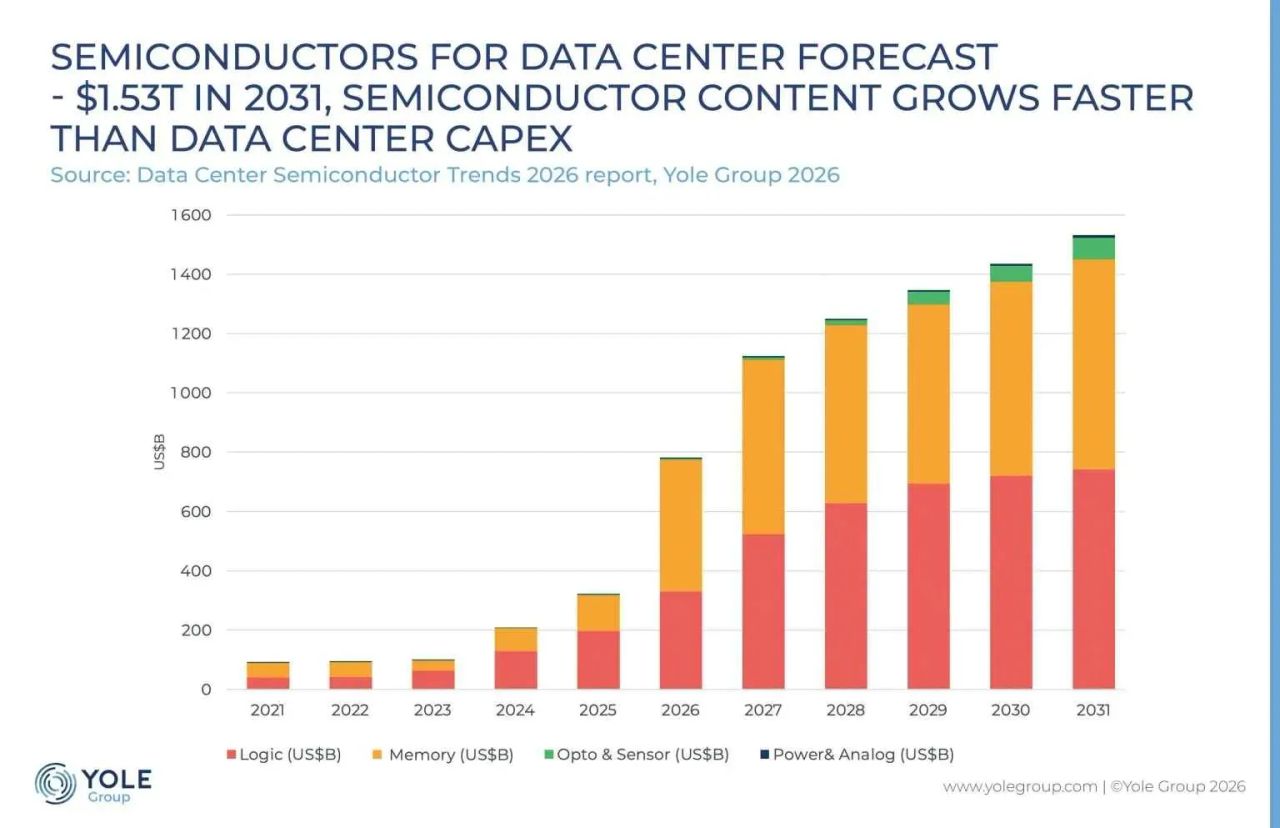
The unit of value in AI infrastructure is quietly moving up the stack. Yole's framing captures a structural shift: buyers no longer price performance by the chip but by the rack, where custom ASICs, HBM4 stacks, advanced packaging, and interconnect are co-optimized as one system. That reorders who captures margin. Hyperscalers and AI labs designing their own accelerators are compressing the merchant-silicon opportunity while expanding the value pool around integration, thermal design, and memory bandwidth. If the datacenter semiconductor market is on a path toward $1.5 trillion by 2031, most of the incremental dollars accrue to the parts of the chain that make many dies behave like one machine.
The global implication is a bifurcation. Front-end logic fabrication concentrates further among a handful of leading-edge foundries, but the strategic bottleneck migrates to packaging, high-bandwidth memory, and system-level assembly. Power and land become the binding constraints, which is exactly why gigawatt-scale projects like TCS's roughly $7.4B facility in southern India matter: capacity, not just chips, is now the scarce asset. Whoever controls advanced packaging throughput and energy access shapes the pace of frontier-model deployment.
For Japan, this is a favorable repricing. The country does not need to win the leading-edge logic race to benefit when value sits in the rack. Japanese suppliers hold entrenched positions in packaging substrates, photoresists and specialty materials, deposition and dicing equipment, and back-end test — precisely the layers gaining share as HBM4 and chiplet integration become the differentiators. Rapidus aside, the durable advantage is in the ecosystem feeding every hyperscaler's ASIC, regardless of whose logo is on the die.
For Japanese SIers and enterprise IT, the shift changes procurement logic. Buying compute increasingly means buying pre-integrated racks and reserving power capacity, not negotiating chip SKUs. That favors integrators who can broker capacity, design liquid-cooled facilities, and manage multi-year power contracts over those still selling server boxes. Domestic development teams should expect AI compute to be provisioned as rack-level or regional-capacity commitments, pushing cost planning toward energy and thermal envelopes rather than per-core pricing.
The risk for Japan is passivity. Owning critical materials and packaging steps grants leverage only if firms move up into system-level co-design partnerships with the labs defining the rack. The window is the same one TCS is exploiting in India: capacity buildout is happening now, and supply-chain positions locked in during this cycle will define margins through 2031.